Last fall I gave a talk at my favorite library in the world: my hometown Morristown and Morris Township Public Library in Morristown, New Jersey.
Morristown and Morris Township Public Library in Morristown, New Jersey
So many high school friends of mine came, and fans of my mom, Joan, author of Home Front Girl, arrived in droves–even in wheelchairs. It was really amazing.
My high school pal and fellow thespian, Tony Boyadjis, and I reading “Frazier” and “Joan”
The reporter, Lorraine Ash, did a beautiful job summing up the event. You can read her article here. What really touched me was how she also wrote about my mom’s other books, as well as my dad’s “seminal textbook,” Organic Chemistry. Since everyone in our family has published books, my mom called us “The Morrison Writing Factory.”
Hubbub after the talk
Those words still ring true. After the physical copies of Home Front Girl: A Diary of Love, Literature, and Growing Up in Wartime America, written by my mother Joan and edited by me, arrived in fall 2012, the kids eagerly each grabbed a book. Chatter and delight.
“My name appears twice,” crows Sarah, who is not only mentioned in the Acknowledgements but also credited with the book jacket photo of my mom and me. While Jim had taken the photo, Sarah touched it up and focused it in that magical way only experts on Photoshop can (more on her expertise in other posts).
Meanwhile, John gloats about how I describe him in the Acknowledgements. “She says I’m ‘tender-hearted!'” he triumphs in a distinctly untender-hearted manner.
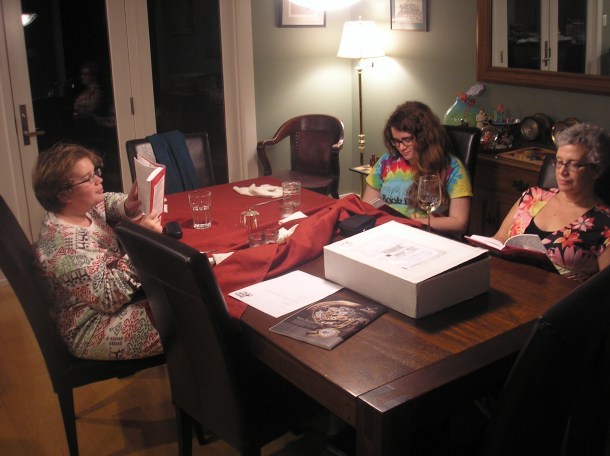
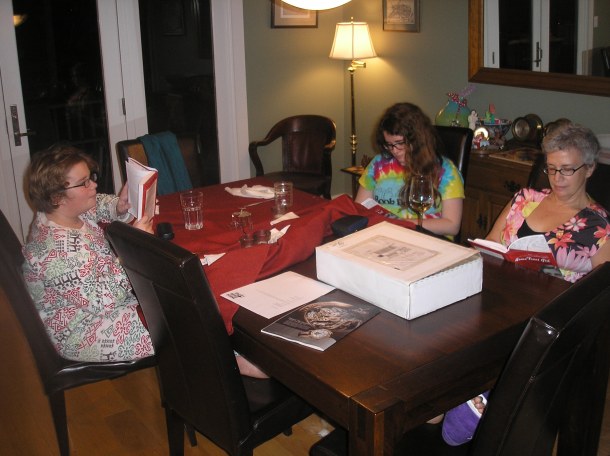
John, Sarah, and Susie reading Home Front Girl around the dining room table.
Then we all settle in to read while Jim prepares dinner. All are intent on the book. Occasional banter bubbles up about some word or line of Grandma’s.
At one point, Sarah says, “I say ‘purdy good’ just like Grandma does here.” She seems pleased to find this link between herself and her grandmother. Little does she know how many more there will be that she will discover! Beyond how everyone thinks she looks like Joan.
The quiet grace while reading Home Front Girl
At dinner Sarah tells about how, when she couldn’t fall asleep the night before, she created a television series in her head about a post-apocalyptic world. John pipes up suggestions and soon–they’re off to the races. Creating, describing, fashioning dialogue.
A new generation of what my mother dubbed our family, all of whom write: The Morrison Writing Factory.
The National World War II Museum is an amazing place. So warm and welcoming. Veterans of the war greet you as you enter. And the exhibits, films, and artifacts are unique. I had a wonderful time doing book signings of Home Front Girl there twice. Currently they have a fascination exhibit on propaganda posters of World War IIl. Look at the amazing ones they feature here.
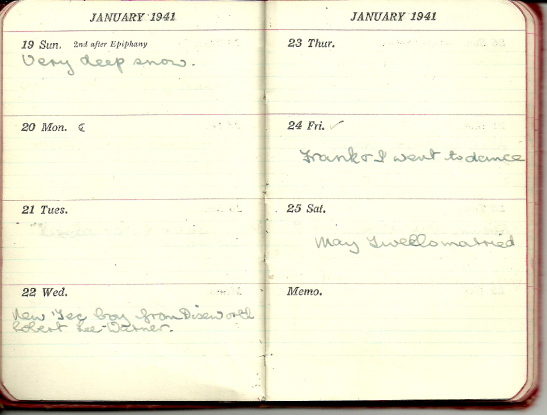
10th: Helen, Ma and I went to Long Eaton to buy coat for M.
13th: Washing. Good day.
15th: Started school. Kath form captain. Raids.
18th: Ma went to Dr about her hand.
19th: Very deep snow.
22nd: New Tec boy from Diseworth Robert Lee Warner
24th: Frank & I went to dance.
25th: May Twells married.
Norah is more tweet-like than ever at the start of 1941. The weather is bitter, so cold that Marsie needs a warmer winter coat. The latest local bombs have dropped on the starfish sites located at the edges of the villages of Diseworth and Wilson. A New Tec boy is her latest crush and…
Today is Presidents’ Day. You can follow a slideshow about all the presidents here.
When I was a kid, we celebrated George Washington’s Birthday (February 22nd) and Abraham Lincoln’s Birthday (February 12th) separately. They also did in the 1930s and 1940s when Joan was a girl.
D. W. Griffith produced a film telling the biography of Lincoln in 1930. It was written by Stephen Vincent Benet--a Pulitzer Prize winning author much beloved by Joan. Here is the movie in its entirety.
Joan writes about both presidents Washington and Lincoln when she is sixteen years old.
Sunday February 12, 1939
Well, here is Lincoln’s birthday again—and surprise—I haven’t written a poem about it. Usually, you know, I write a poem regularly about every holiday we get out of school for—and even some we don’t. Oh well. I always liked Lincoln better then Washington…
She does seem more interested in Lincoln. He shows up a lot in her diary. After the war is well underway in Europe and North Africa, Joan reflects on the passing of life. This passage she wrote when she was 18 years old.
Thursday January 26, 1941
Beauty is unbelievable, isn’t it—all things superb, all tears for loveliness, all sweets, and all colour is in her…Oh beauty, nothing is as real, yet as unbelievable as beauty! —I’ve been standing at the kitchen window while the Tales of Hoffman played on the radio, watching the large snowflakes drift over the roofs…the church tower dim and grey and the sky like the grey-white sea…Oh beauty.
You can listen to the Tales of Hoffman just like Joan as you read on.
Perhaps the world is changing and we shall never get it back the same…But I think the things to be remembered will be different from what we think now. I don’t think so much I’ll remember Dik, Larry, meteors I made so much noise over—but rather the sweet friendly face of Clyde Johnson, laughing with me in Harpers [Library]—Or Bud, singing “Auld Lang Syne” with his Bear’s grin. The funny unsophisticated people. The dependable ones we laughed warmly at. Calvin—running his fingers through his hair…Oh friendly, lovely world…Every quiet day is equal to every day of comet glow…Sweetness of world…I’ve been to church today too: “Whosoever drinketh of the water which I give shall never thirst.” Twice this afternoon they played “La Golondrina” on the radio and I recaptured from its notes Joe picking it out on his mandolin that first mad day on the station wagon, later in quiet night….Unbelievable quiet…oh world! (This was life, this was living).
You can hear La Golondrina here and read a translation of the lyrics here.
…British have captured Derma. All the faery-tale cities of the world—are real…Derma, Tobruk. Oh world.
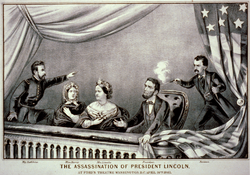
The Assassination of President Lincoln *from left to right: Major Henry Rathbone, Clara Harris, Mary Todd Lincoln, Abraham Lincoln, and John Wilkes Booth
A short while later, Lincoln’s Birthday arrives.
Wednesday February 12, 1941
Hello!…Well, Lincoln’s birthday. Stayed home alone and read “Das Abenteuer der Neujahrsnacht” for German…. Heard Wilkie[1] on radio tonight…Wants lots of aid to Britain….
Wendell Willkie
Gabriel Heatter. He always has that way of making you think “Tonight’s the night: –“These are the days”. Anyhow, Franco has just met Mussolini…is to meet Marshall Petain tomorrow. Rumours of peace between Italy and Britain. Italy badly needs it—or so we’re told…’Nuff of Europe….
[1] Wilkie an unsuccessfully as a Republican for President in 1940. Gabriel Heatter was a famous radio announcer.
Gabriel Heatter. “There’s good news tonight” was a catchphrase of his.
You can listen to him announcing WWII news at this site where he talks about the “Latest Nazi Claims.”
All is not gloom and doom. Joan manages to retain her sense of humor. Weeks after Pearl Harbor,
Photograph from a Japanese plane of Battleship Row at the beginning of the attack of Pearl Harbor.
Joan writes about running into a beau, Bill Knisely.
3:15 AM Sunday Morning Dec. 21, 1941, Age 19
After teaching today went to bookstore to get stamps. Bill was quite flustered and gave me $1.25 change for a dollar. I gave it back. Me and Lincoln. Later he called up and asked me out for tonite, but I had a date already.
The “he” asking her out for a date was Bill, not Lincoln! Joan’s sarcastic reference mocks herself, while referring to Lincoln’s extreme honesty–“Honest Abe.”
Her jokes continue despite the oppression of the war.
Thursday February 12, 1942
School even today. Lincoln’s birthday, of course, but it’s not supposed to be patriotic to have holidays now. Wartime, you know…Tomorrow Mr. Ashford is going to set off an incendiary bomb in Phy Sci [Physical Science]. If I don’t reappear, you’ll know why.
In February 1939, Joan had commented on how she had not written a poem in commemoration of Lincoln’s Birthday. But she did compose one a couple of weeks later– an impassioned poem that seems to sense the coming war.
She was an integral part of my childhood. Beaming to New Jersey, the minor New York stations would show “old movies” (in black and white!) on the weekends. Many a time I saw Shirley singing, dancing, and cheering people up — during the Great Depression and in my own time too.
This is one of my favorite songs from Curly Top (1935). It’s called “Animal Crackers in My Soup.”
And my singing voice is none too true (just ask my kids!). But she had a super voice. Listen in to her in Bright Eyes from 1934.
But I did identify with her since I have a pretty sunny disposition.
Here’s a lovely film from 1935. You can watch the entire movie: Our Little Girlfrom 1935.
What a talent she was! And then to grow up and become a diplomat –to remake herself as it were– deserves our respect and admiration just as she showed respect to performers like the amazing Bill Bojangles Robinson here in The Little Colonel (1935). National Tap Dance Day is named for him!
She was important to girls in the 1930s–and to everyone! Joan mentions her in her writings–though not as you might expect. One joy in rediscovering my mother’s diaries was seeing how she was simply a girl. You don’t often encounter your own mother as a girl, but I had the privilege to.
Shirley shows up in some pages of her diary. But not where Joan emotes about crushes, or complains about her parents, or wonders at the universe. Shirley shows up when Joan is playing hangman, that venerable custom for old and young. Joan wrote this Monday October 10, 1938 when she was 15.
Hangman: Shirley Temple, Tyrone Power, and Mickey Rooney. You can read about another hangman game here.
It shows how important movie stars were to kids, just like pop stars are today (please don’t ask me about One Direction–I hear them plenty in my house!). Tyrone Power, dark and dreamy, and Mickey Rooney, the safe kid one who love as a pal, also show up on this page.
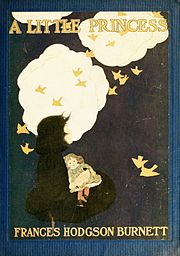
And should you ever need cheering up, just see this whole movie below: The Little Princess. This 1939 film, starring Shirley Temple, was based on the beloved novel by Frances Hodgson Burnett.
The original cover of the 1905 novel.
Thank you, Shirley, for all the joy you’ve given us. The best way to show our respects to her is to see her films. So enjoy–and don’t forget the popcorn!
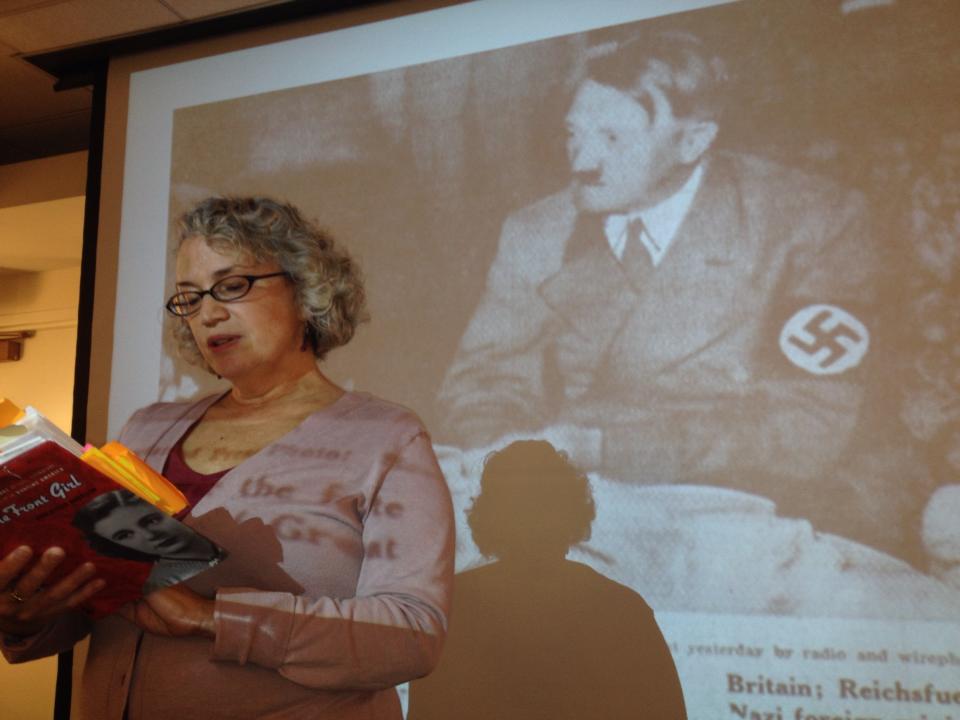
Reading a section of Home Front Girl in front of an image from Joan’s diary: a clipping from the newspaper during the appeasement talks in September 1938
How often I’ve trod those floors! First in the children’s room, than gradually working up to chapter books. As my dear friend, Beth Carroll, said, “If you got the first book as a gift, you could go to the library to get all the rest in the series.”
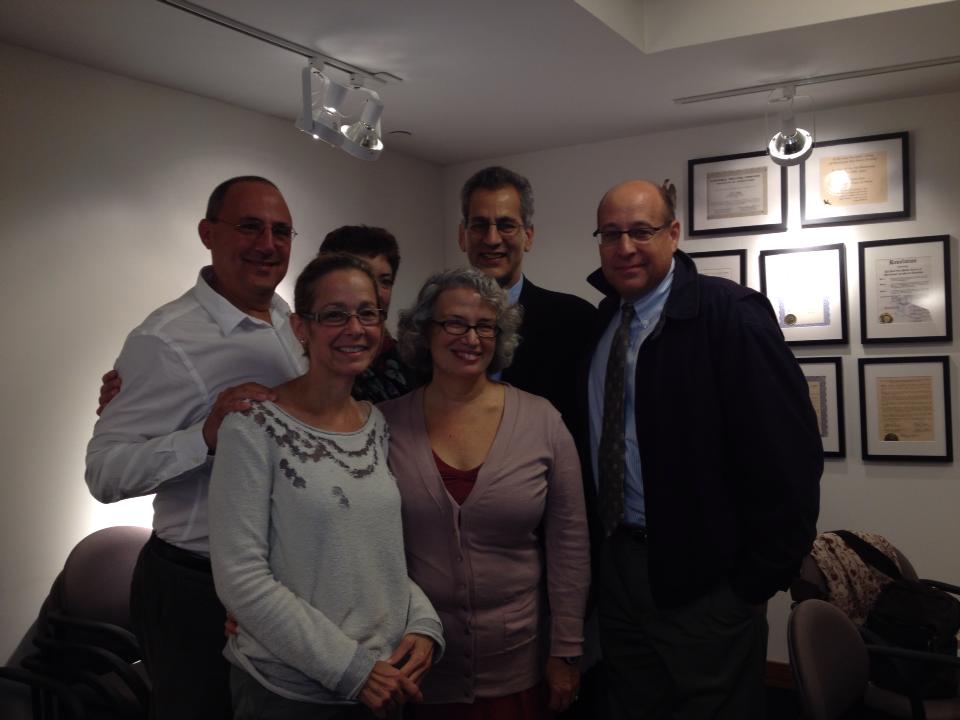
Here Beth and I are with other high school friends, years after we first met in third grade.
Ken Goldman, Lauren Roscher Boyadjis, Tony Boyadjis, Bill Schlosser, and, in front, Beth Carroll and me.
Libraries seem to link friends and family. Joan writes about libraries in Home Front Girl many times, as I’ve commented on in a previous blogpost. There’s something about the promise of books and the worlds they contain that makes heart open as you enter the hallowed doors. They can even be romantic, as Joan writes about her summer camp experience with a short-time boyfriend, Burman. She wrote this when she was 18 years old.
Saturday, August 30, 1941
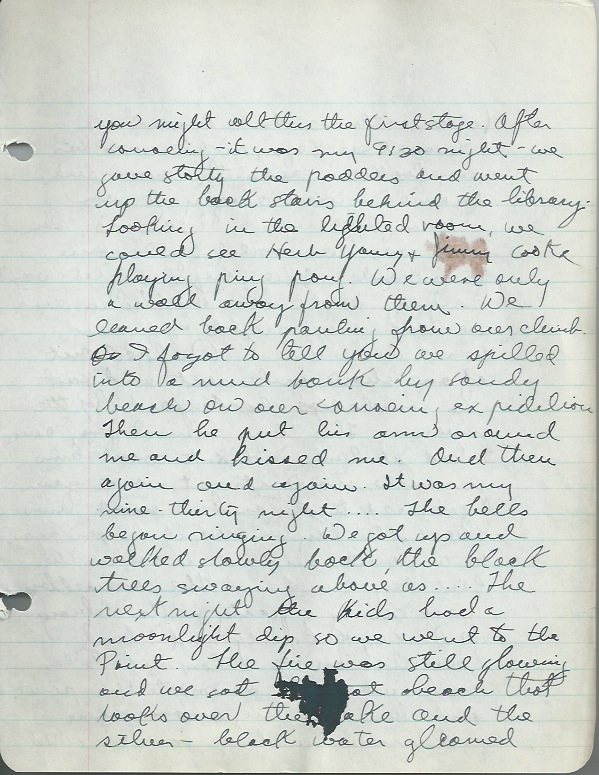
After canoeing—it was my 9:30 night—we went up the back stairs behind the library. Looking into the lighted room, we could see two boys playing ping-pong. We were only a wall away from them. He leaned back panting from our climb. I forgot to tell you we spilled into a mud bank by Sandy Beach on our canoeing expedition. Then he put his arm around me and kissed me. And then again and again. It was my 9:30 night . . . the bells began ringing. We got up and walked slowly back, the black trees swaying above us. . . .
The next night the kids had a moonlight dip, so we went to the Point. The fire was still glowing and we sat overlooking the lake and the silver-black water gleamed far beneath us. As he kissed me, I could see Vega, right over his ear, looking sedately down and for once I was angry at her complacency. Of course, she knows the world will come to an end!
From Joan’s diary: Saturday, August 30, 1941. Note the blotched ink.
The next night was Friday and his birthday and we took our night off and went into Niles. Walked out of one show and went and sat in somebody’s backyard by the river. . . . This time, mind you, since I had got him, I didn’t want him so much; now it’s got worse again. I get used to him and I miss him. Then Saturday we went down again to the point and then came the last day Sunday.
The counselors were giving a party in the library and I had permission to stay out late and we went down to the point and built a huge campfire and moved a log so we could look over the lake. It was like the first campfire there ever was . . . and a man and woman. Night all full of soft sounds of insects about us. . . . The moon, a new one, like a bent feather in the sky and a spangled reflection of her lying in the river. . . . The soft hot wind. . . . It was the last night.
Finally we went back and joined the party. . . . They began singing in there. Soft old songs, “Love’s Old Sweet Song,” “Auld Lang Syne,” “Missouri Waltz” and then they began “Smile the While”[1] and I grew suddenly cold for a moment.
The tradition of growing up in libraries continues. My daughter, Sarah, has volunteered for two summers in the Hull Public Library in Hull, Massachusetts.
Hull Public Library in Hull, Massachusetts. Formerly the home of Irish writer, John Boyle O’Reilly.
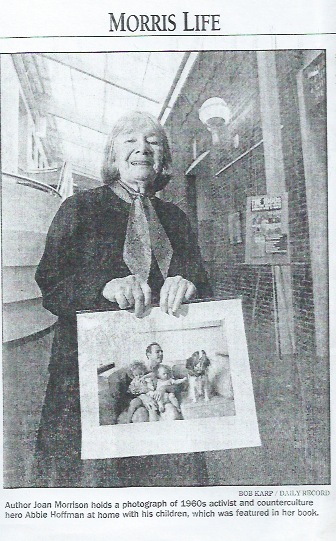
And my mother, Joan, when she was older than her teenage diary years, spoke at many a library. She spoke at the Morris Country Library in 2006. And the reporter who wrote about her was….Lorraine Ash, who wrote about my library talk in October 2013.
Joan at age 83 in an article by Lorraine Ash for Morristown Daily Record, April 20, 2006.
Libraries bring us together in ways we never could have imagined when we are young. Going to my hometown library was poignant, touching, but also fulfilling in a way I never expected. And all thanks to those who made the talk possible, most especially, my mother — Joan Wehlen Morrison.
Bill Knisely was my mom’s beau just as the U. S. entered World War II. The night before Pearl Harbor, Joan went to see Citizen Kane with him and some other pals. Unfortunately, they had to leave the movie early, leaving Joan to puzzle, “Who the heck was Rosebud?”
As I was researching for the publication of Home Front Girl, I wanted to find out what happened to Bill. Lo and behold, though Bill had passed away, his son and wife lived in my town! So I looked them up and we have had several lovely encounters. Recently Bill’s son Paul sent me some World War II photos from The Denver Post. They are spectacular. I will share some here, but do go to this page to see their selection.
Note the news headlines posted on the store, including “Prince Calls on Roosevelt” and “[Churchill] Urges Italians Oust Mussolini”
Taken by the Farm Security Administration/Office of War Information between 1939-1943, they bear witness to the effects the Great Depression had on rural — and urban — America.
Chopping cotton on rented land near White Plains. White Plains, Greene County, Georgia, June 1941
I was most taken with the photos from Chicago, Joan’s hometown. A number of them show the railroad yard.
Putting the finishing touches on a rebuilt caboose at the rip tracks at Proviso yard. Chicago, Illinois, April 1943.
My grandfather worked for the railroad in Chicago. He could have been this man, Mike Evans.
Mike Evans, a welder, at the rip tracks at Proviso yard of the Chicago and Northwest Railway Company. Chicago, Illinois, April 1943
Maybe my Grandpa even knew Mike.
General view of part of the South Water Street freight depot of the Illinois Central Railroad Chicago, Illinois, May 1943
Women working for the war effort or taking over men’s jobs also appear in this photographic archive.
Women workers employed as wipers in the roundhouse having lunch in their rest room, Chicago and Northwest Railway Company. Clinton, Iowa, April 1943.
Woman is working on a “Vengeance” dive bomber Tennessee, February 1943. Reproduction from color slide.
Even children’s classrooms provided no escape from the war.
Rural school children. San Augustine County, Texas, April 1943.
This last picture below from the Calumet City railroad yard harkens to a moment in Joan’s diary.
Switch engine in yard near Calumet Park stockyards, Indiana Harbor Belt Railroad. Calumet City, Illinois, January 1943
Joan writes an entry in her diary early in the morning after her 19th birthday on December 20, 1941, just a few weeks after Pearl Harbor. The U. S. may be at war, but teenagers still have to be young.
3:15 AM Sunday Morning, December 21, 1941
Well, here I am healthy and hearty in spite of my old age of nineteen and feeling like the living example of late hours bring on good health. I feel as if I could lick 20 Hercules, though I probably couldn’t. Kenny and I were going to go out to Calumet City tonight so he arrived at eight after Paw and I had just had a birthday feast of chicken and the darlingest cake!—and wine. And he got me the cutest Baby Ben alarm clock!
Anyhow, Kenny arrived and we went to Jack’s house and drove with Jack et [Latin for and] mates to 63rd and drove around while they shopped and took mates back and Kenny and I went to his house and I met his mother and dad—she’s much younger—both of them are—than I expected. Very nice and asked me to dinner sometime, etc. He tells me Ruth (his sister) approves of me too. He said he wanted me to meet his parents ’cause they say he never goes out with a nice girl. . . .
We ate and then to Cal City. Beautiful drive. Stars all frosty and a-gleam and red fires of steel mills and we passed a train of tanks on the way back and a policeman or soldier at every bridge.[1] They wouldn’t take me in any place out there—it must be purty bad—except the Siesta Club and we couldn’t get a table there so we came back—all frosted night—to Zebra Lounge—drank—then to bowling. I did 64. I’m improving and then played shooting at submarines. I got 8,000, Jack 8,900, Kenny only 4,000. Washington should hear of this. Jack, too, is subject to draft now by the way. . . . Kenny got me a lipstick and Lucien Lelong Poker Chip cologne.
Purty smell. . . . Just think—I’m nineteen now. I feel old and sophisticated.
[1] They were there for security purposes, in case of sabotage.
Even though they are having fun, the war pervades the atmosphere: the “train of tanks” with police guard, playing at shooting submarines [“Washington should hear of this”], and how the boys are “subject to draft”.
Snapshots from real life, visual and verbal. They remind us how tenuous our present is, yet also how they can flare back into view, with a photo or diary.
The National Archives has just begun the process of making public the diaries of World War I soldiers. About 20% of the more than 1.5 million pages are now available for the world to read. All military units had to keep a daily log about what happened that day. This information is now available to all of us, as the New York Times reports. You can explore more about it here.
Other diaries are coming to light, such as Cyril Helm’s. His grandson, a journalist for The Observer, beautifully commemorates his grandfather’s recording of history. Cyril, a medical officer, writes in 1914, “Many fell in our frontline trenches, causing awful casualties. Men were buried alive whilst others were just dug out in time and brought to, unable to stand, with their backs half broken. My cellar was soon packed, but I could not put any wounded upstairs as any minute I expected the place to be blown up.”
Diaries are a guide, illuminating darkened interior pasts.
Diaries from the home front are likewise crucial for understanding how people at the time understood war. You cannot understand World War II without understanding the “Great War” (World War I). Joan’s diaries ponder that prior war just as World War II is heating up.
I have been reading about the [World War I] dead and am thinking how awful it must be for a mother—or a father—to know their grown son dead. After bearing and bringing through childhood to the prime of his life a son—to find that all this is futile, that all this is ended—all vain. That he died before he began to be himself. To lose a child must be in a deep sense far worse than to lose a husband. It must make one lose the sense of continuity. . . . A husband dead means that you are, in a way, dead—but to lose a child means you lose immortality—that you shall not go on. . . .
[1] Ironically, Joan wrote this entry before she knew World War II had begun on this day.
Joan at summer camp on September 1, 1939. You can see Joan wrote exclamation marks after the date.
Whether in a trench or safe at home, diary expose the thawing of innocence and hope.
In a gigantic crowd sourcing effort, the National Archives are seeking volunteers to tag data. You can participate here. Help make history.
My daughter, Sarah, is 17, but we still receive the American Girl doll catalogue. Imagine my shock when I saw that Molly McIntire and her English friend, Emily Bennett, were to be “archived.” I guess that means they’ll be shelved for now. I’ve always had a fondness for Molly since her story is set in 1944 and her home front hi-jinks appealed to me. Yes, yes, I know how commercial it all is, but there’s a part of me that is glad girls associate historical fictional girls from the past with narrative.
Molly McIntire and Emily Bennett, her English friend escaping the London Blitz.
I first encountered the American Girl doll phenomenon through two girls we knew when Sarah was very little, Jenny and Molly Odintz. I think they had a doll or two, though they giggled over the unlikely ability of Addy, the escaped slave, to own $30 accessories! And they dearly wanted a Jewish doll which American Girl finally provided.
Sarah got some American Girl dolls from Joan, her grandma–Kit Kittredge, the 1930s doll, and Samantha, a girl from a “bright Victorian beauty.” Sarah was never that much into them, but they still sit atop her bookcase. She even has that English girl who has fled the Blitz, Emily Bennett!
The Four Fates, as my husband, Jim, likes to call them: Emily, Kit, a doll from Poland, and Samantha. A little stuffed bug (representing the disease ‘mono’) sits in front.
Dolls are wonderful beings, though I think Sarah’s and my interest in American Girl dolls dissipated when we visited the actual American Girl doll store in New York City a number of years ago. The scary intensity of the buyers with their brutal focus on consumption turned us off, though we had many a giggle over it!
Dolls are important for girls to learn to express themselves. I often acted out stories with my dolls and stuffed animals. In 3rd grade, my teacher let me perform little plays for my classmates using my stuffed animals and troll dolls. I also had Barbies, though Barbies were for older girls in those days, while little girls receive the physically impossible plastic siren today.
Joan writes about wanting a doll when she is almost fifteen.
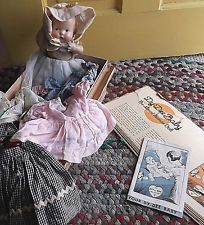
Dy-Dee Doll advertisement.
Wednesday, December 8, 1937
. . . Last week Mrs. Topping read my “Lonesome Pine” composition to the class and said it was writing at its best. Ah! Then she asked the class if they didn’t feel something good in it—so they said “no,” but Mrs. T. appreciates me—I hope. . . .
Last Saturday I went downtown and saw Santa Claus, etc. They’ve got the cutest dolls there—I want one for Xmas even if I am almost fifteen—but I want a set of O. Henry,[1] too—even more. Honestly, I’m practically a little girl when it comes to Xmas displays. I’ll stand for an hour and watch someone demonstrate “DyDee” dolls or something.
A few months later, a wonderful gift arrives for her.
Age 15, Thursday, April 21, 1938
. . . Last week Vera and I went to Mary’s house and I fell in love with her ragdoll, and when the club met there Friday, I found a doll there with a card saying “To Joan Whalen [sic]—my name is Penelope and I am a platinum blonde” and Mary really had made one for me—I think that was nice of her.
Then a couple of months later…
Wednesday, June 15, 1938
. . . One girl had a Dionne quintuplet[1] doll in art and I had the best time playing with it. Everyone was teasing me about second childhood. Have I passed yet from my first? . .














 Home Front Girl