Category Archives: Susie’s Blog

Animals in the Second World War in England

Animals have all too often been overlooked as victims in war. Two books examine their lives and deaths. The Great Cat and Dog Massacre: The Real Story of World War Two’s Unknown Tragedy, by Hilda Kean, examines the euthanasia campaign conducted by the British government in the opening days of the war. The New York Times review by Elena Passarello writes that, “Amid protests from government officials and animal charities, and despite the absence of any attack on British soil (the Blitz would not begin until 1940), an estimated 400,000 pets were killed in that first, silent week of war.”

Another of these books, Bonzo’s War: Animals Under Fire 1939–1945 by Clare Campbell, chronicles the trials of animals in Britain during World War II.

Public Information Poster

Public Information Poster

Imagine what your dog or cat would experience. All the noise and terror.

 Women queue with their pets at a Narpac (National Air Raid Precautions Committee) post in Holborn, London, 1940

Women queue with their pets at a Narpac (National Air Raid Precautions Committee) post in Holborn, London, 1940

This dog was trained to sniff out bombs and mines.

Pet dog loaned to army to sniff out mines in 1944

And here is one of a horse.

 'The West Ham Borough Council Veterinary Department have devised a special gas protection bag for horses, and have instigated a corps of men and 21 dressing stations for any of the borough's 200,000 animals in the time of war. It is a large nose-bag which fits over the horse's head, and is fixed with a zip fastener, the idea being with a little food in the bag the horse would be quiet during an air raid. A long halter is also attached to allow the driver to get to shelter and still have his horse under control. The fetlocks are bandaged with special oil-skin to protect them from mustard gas'.

‘The West Ham Borough Council Veterinary Department have devised a special gas protection bag for horses, and have instigated a corps of men and 21 dressing stations for any of the borough’s 200,000 animals in the time of war. It is a large nose-bag which fits over the horse’s head, and is fixed with a zip fastener, the idea being with a little food in the bag the horse would be quiet during an air raid. A long halter is also attached to allow the driver to get to shelter and still have his horse under control. The fetlocks are bandaged with special oil-skin to protect them from mustard gas’.

A happy boy with his pet.

 A boy with a cat in London during the blitz, 1940

A boy with a cat in London during the blitz, 1940

All photos from the Guardian website.

This attention on animals in war should make us aware that other living creatures in addition to humans suffer from man’s inhumanity to man–and animal.

In Home Front Girl, Joan ponders the differences between man and animal while riding a bus when she is fifteen years old. She seems to pique the interest of the man sitting next to her!

Sunday, October 30, 1938

I went back to the difference between man and animals. Very slight, it seems. I was testing myself out to see if I was human. Seeing if my thumb was opposable (by wiggling it) and if I had definite chin (thrusting it out) and if my great toe was opposable (very hard in shoes). By this time, the man next to me also seemed to need proof that I was human and took quite an interest in my experiments. In most points I seemed human so I gave up and went back to one-celled animals. Man went back to his magazine.

“Very slight” difference between humans and animals–in war and peace.


Home Fires Keep On Burning

So excited that the ITV World War II show Home Fires will keep on burning! Read more about it here.


Female War Correspondent Who Broke Start of WWII Passes Away

 Clare Hollingworth in 1985. Credit United News/Popperfoto, via Getty Images. From The New York Times.

Clare Hollingworth in 1985. Credit United News/Popperfoto, via Getty Images. From The New York Times.

Clare Hollingworth, who died this week at the age of 105, broke the news of the outbreak of WWII when Germans invaded Poland. Her life is fascinating. You can read more about her here and here.

My mother, Joan, writes about the outbreak of the war in this poem she wrote at the age of 16.

A photo taken while she was a nature study counselor in Michigan. It was taken the day the war began, before she realized it. Below she has written, "September 1, 1939!!!"

A photo taken while she was a nature study counselor in Michigan. It was taken the day the war began, before she realized it. Below she has written, “September 1, 1939!!!”

After 12 – Sept 27 – 1939                                                                             

                        In Memory – August 31, 1939

I remember standing in the crooked shadow of the Catalpa tree

The August-September night it started.

White moon on the grass and moon mist over the fields.

Even then.  It was so still.

The crickets sang farewell to summer.

And the smell of a golden reaping

Was rich in the air.

Even then.  While we were so still

Somewhere the guns were beginning to boom

And another crop was being harvested.

Musicals WWII Soldiers and Sailors May Have Seen

Merry Christmas….from 1932!

My mother, Joan, wrote poetry starting at an early age. Here’s a poem about Christmas she wrote when she had just turned 10, living in Chicago in 1932.

                              Santa Claus!                                     

Santa Claus comes in his sleigh,

Reindeer pulling it away.

Santa Claus comes with his toys,

Coming for the girls and boys.

He will bring a Christmas tree,

One for you and one for me,

He will come down the chimney,

Bringing toys for you and me.

Christmas Display at Marshall Field's in the 1930s or 1940s.

Christmas Display at Marshall Field’s in the 1930s or 1940s.

Blessings to all!


Lost Tapes of Pearl Harbor

 Sailors paying tribute in 1942 to casualties of the Pearl Harbor attack in the new Smithsonian Channel series “The Lost Tapes.” Credit National Archives and Records Administration, via Smithsonian Channel

Sailors paying tribute in 1942 to casualties of the Pearl Harbor attack in the new Smithsonian Channel series “The Lost Tapes.” Credit National Archives and Records Administration, via Smithsonian Channel

The Smithsonian Channel has a new documentary featuring lost tapes about the lead up to the attack on Pearl Harbor, the event itself, and the aftermath. As the Smithsonian Channel page explains, “By September 1940, the world was on high alert: Japan had just entered a pact with the Axis forces, prompting the U.S. to consider a suitable response. Here’s how their entry into WWII was covered by media of the time.” You can read more about it here and see an excerpt at this link.

United States National Archives

United States National Archives

My mother, Joan, wrote eloquently about her reactions to the bombing. You can read an excerpt from her diaries here written on the evening of December 7, after the bombing.

Going Cold Turkey with Thanksgiving Romance in 1941

Cartoon accompanying the New York Times article by Jane Ziegelman and Andrew Coe. Image by Wendy MacNaughton.

Cartoon accompanying the New York Times article by Jane Ziegelman and Andrew Coe. Image by Wendy MacNaughton.

Today the New York Times has an article about Thanksgiving meals during the Great Depression. Things hadn’t changed much by 1941, when my 18-year-old mom Joan wrote one of my favorite passages in her diary concerning her distanced attitude towards a fellow camp counselor. He was sometimes her boyfriend and visits Chicago just after Thanksgiving. They eat cold turkey. That’s not all he wants!

Tuesday, November 25, 1941, age 18

Study French with Mr. Yerke (René) at 11 o’clock. He was in France when the war broke out and was in the American ambulance corps for a week till they found out he was only 18. He’ll be 21 tomorrow. It hardly seems like almost three years since the war broke out.[1] But I guess it is. My oh my. . . .

Burman came in Friday and called me up at 8:30 but we had school even after Thanksgiving (it was the 20th)[2] so I told him to come at one. We ate cold turkey and washed the dishes and necked in the living room and seemed to be having a good time. But I knew it wasn’t the real thing. Hell! . . . Went to movie Bluebeard’s Eighth Wife and necked some more. It was pretty cold out. Got home—ate more cold turkey in the kitchen and then he left. . . .

Oh, life is just toooo delightful. I wonder if I’ll be at school next year.

Hmmm…poor Burman. Joan later knits a scarf for him, but, romantically–he’s history!

Here’s a trailer to the movie they watched. It’s a bit “risqué” and not exactly politically correct in terms of gender politics. It gives added nuance to “the Lubitsch touch.” And did it inspire Burman?

[1] Actually, it was two years and three months.

[2] Thanksgiving was the third Thursday in 1941.

The Sin of Being Patriotic

Joan spouting poetry

Joan spouting poetry

On this election day, I turned to my mother’s diaries from the 1930s for some wisdom. As always, I found it in the voice of Joan at age 15 in January 1938. In this passage, she writes about “The Sin of Being Patriotic.”

The Sin of Being Patriotic

If a reasonable man were to look at it (which he never does), he would easily see the foolishness of what we call by the brave word, “patriotism.” What is this “motherland” we honor? Is it the flag? It cannot be the flag. It is a beautiful thing to be sure—waving brightly in the air, but who will die for a piece of cloth?

Joan on March 1, 1939. Doesn't she look swanky?

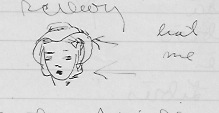
Joan’s doodle of herself in a hat.

You say it is only a symbol; then of what is it a symbol? Of the men who founded a country and who have lived in it? No, for who will die for dead men? Is it the living leaders? No, it cannot be. For if half the country acclaim a leader (which, incidentally it never does), why, then the other half must hate him. So it is not the leaders, for who will die for a despised man even if he be president?

Is it, then, the people—can it be? This hungry, seeking people of whom we are a part—whom—though we are of them, we are a part—whom—though we are of them, we laugh at? Who knows? Men have died for less—and for more. Can it then be for less—and for more?

Joan's sketch of the Fountain of the Great Lakes from May 29, 1937

Joan’s sketch of the Fountain of the Great Lakes from May 29, 1937

Can it then be this last thing, the land? The good black earth with green things that grow and die again—the good black Earth that will cover us all? Is it this that men die for, the symbol at once of life and death? Is this what we die for—our tomb?

Nay—if men die not for any of these things and yet die, do they die for nothing? Are all the souls buried into Earth for naught? Perhaps it is nothing, but I, too, would die for this wrong and beautiful thing that men call “patriotism.”

Yet peace is not so great that we would sell our dreams for her—even if they be foolish dreams.


Chicago and Baseball: Compassionate Community

I was excited that the Cubs won the World Series. I saw them as a kid when I went to visit my grandparents in Chicago. Baseball shows up in the diaries of my mom, Joan, in the 1930s and 1940s. It sparks a moment of communion with a young man whose leg has been amputated.

Saturday, May 31, 1941

. . . Went to Billings this morning [to volunteer] and, as they had measles, they sent me downstairs to read Captain Horatio Hornblower to a boy. Turned out to be Joe. . . 19-year-old freshman from Purdue. Leg amputated just last week. Hurt it playing basketball. Nice-looking boy with good lean features, bright blue eyes and dark hair. I didn’t read at all, we just talked—about college and everything. . . .

Wrigley Field in 1935

Wrigley Field in 1935

And all the sudden leaning there on the bed—he was telling me how he felt at first and I thought my god, he’s got one leg cut off—oh poor boy—how terrible! — but I couldn’t let him see I was thinking it. . . .

Somehow then the scene from All Quiet on the Western Front came back to my mind—where the two soldiers visit their friend whose legs have just been cut off and they realize how helpless they are—and I had that same feeling. So I smiled foolishly and we went on talking about college and baseball. . . . And I think perhaps he was fooling me, too, talking about such trivial things—when there was a consciousness of something else there . . . A nice-looking boy I might play bridge with in the Coffee Shop or meet on a double date. People, all round the world.

But he said, “I’m not going to let this thing get me down.” I felt so moved in front of so much reality. After a while, my friend, Emily, came for me and we laughed that we hadn’t been reading at all. Well, Joe Harmon, good luck to you. . . .

Time goes on . . . as I rode home I thought of that phrase of Francis Bacon’s in his utopia[1]—used of the Governor, “He had a look as if he pitied men,” and I think that it the most beautiful trait of all—“a look as if he pitied men.”

Trivial things–like baseball. But baseball allows us to build community and pierce through the walls we build up to protect ourselves. On the field, in the stands, or in our homes, we find mutual joy–together.


[1] Francis Bacon, who died in 1626, wrote of a utopia in New Atlantis.

World War II Woman Pilot Buried at Arlington Cemetery

Elaine D. Harmon

Elaine D. Harmon

WASPs, members of the Women Airforce Service Pilots, can at last be buried at Arlington Cemetery. Elaine D. Harmon was interred on Wednesday, September 7, 2016, at Arlington Cemetery, the first WASP to be so honored. Read about this moving story from The New York Times. Joan would have appreciated the poetry read at the ceremony. You can see a video about the ceremony here. As the NYT article by Nicholas Fandos describes it,

“Lt. Col. Christine Blice-Baum, a chaplain, read from Scripture and then from a poem, “Celestial Flight,” written by one WASP, Elizabeth MacKethan Magid, in remembrance of another:

She is not dead.

You should have known

That she is only flying higher,

Higher than she’s ever flown.”