Touching Generations
Please read my article on the Swarthmore College Bulletin Website:
“Touching Generations: Ink on paper still resonates across the decades.”
Happy New Year: December 31, 1937
This is what my mother, Joan Wehlen Morrison, wrote one week after she turned 15 years old, on December 31, 1937.
Friday, December 31, 1937
I had the awfullest dream last night. I dreamt a war was begun and people were running about with brightened looks in their eyes. I was a boy and I knew I would have to be a soldier. I was afraid to go to war. I kept seeing trenches and mud and horror and pain and things—and killing people—and I was terribly scared inside. But I knew I would have to join the army anyhow because otherwise people would call me coward. I went to enlist and that’s all I remember. I figured I might have three months in a training group before I would have to fight. It was a terrible dream and I was so scared. That’s all I remember. . . .
I sit here and wait for the last minutes of 1937 to come to an end. 1937 sounds like such a momentous year—like 1492 or 1066 or 1588 or 1776, doesn’t it? I’m sure it marks a crisis in our history. But 1940 sounds even greater—well, we must wait.
I’ve been reading my journal over, my journal of this year—and plenty seems to have happened. A king has been crowned—England’s George VI. Edward married Wallis

Wallis Simpson and Edward VIII, who abdicated to marry “the woman I love.”
and closed that part of England’s history—or did he? The Spanish Civil (?) War continued and the Japanese began and conquered an undeclared war in China. Now the civilization of thousands of years is under the flag of the rising (or setting?) sun of Japan. . . . Add to things that have happened: the Hindenburg, last but one of the great airships, burned to cinders in New Jersey. . . .
P.S. Marconi[1] also died this year.
[1] Winner of the Nobel Prize in Physics, who was also considered the father of the radio.
Happy Holidays from 1937, 1939, and 2012 — 1940 is less happy…..
As Joan wrote in her journals over 70 years ago:
[Age 15] Dec. 25, 1937
Hello! It’s Christmas Day! Isn’t that a lovely word—“Christmas”—the very sound of it makes you think of bright snow and blue stars and shining laughing things – especially the “Christ” part – the sound of the word is like bright snow or sunlight. The sound of “God” makes you feel strange too. Not like “Christ,” not bright and shining, but like something glowing deep within you. Words – some of them – seem to come from the very heart of men —some bright and some deep within you. Words are terribly beautiful—sometimes.
December 25, 1939

A clipping from Joan’s scrapbook. A photo from the newspaper in Chicago, 1939.
[Age 18] Christmas 1940
Then on Michigan Blvd I passed suddenly the Cunard window…. An exhibit for the BWR [British War Relief]—pictures of little children in Britain—homes bombed—helmets that could be knitted for the RAF—a noble purpose—but it’s making war in our hearts…The little German children are bombed and hungry too…And all the sudden, in an emotional intensity, I thought, “This may be the last Christmas we shall have”…Christmas 1940…I should be wise and know the world will never end…Time is a funny mirror—sometimes the image is distorted…An unofficial truce played over Christmas in Europe today—Hitler said, “German fliers will not fly on Christmas if British flyers will not.” And they did not…And so a white bloodless Christmas there and the sky is weeping here…Christmas 1940—
And from Jim, Sarah, John and me (Susie): Merry Christmas 2012

Here we are with our dear friend, Don Singer–Happy Holidays to all!
Dedicated to those brave heroes: Life as part of the crew of a Stirling Bomber
A dear friend in England sent me this link to the website at the BBC called WW2 People’s War.

Pete Smith is a delightful raconteur and eminent scholar, and shared his dad’s adventures with me. Here is one hair-raising story his dad, Roy Smith, shares on the website:
“[S]etting out for a trip to Mannheim, and routed over N.W. London, it seemed that the ground defences had not been informed and we were subjected to some anti-aircraft fire. George, our wireless operator, fired off the colours of the day to no avail. As a precaution, the flight engineer opened the hatch, in case we had to make an emergency escape. Our mid-upper gunner bent down from his turret to see what was going on and seeing the hatch was open, switched on his intercom to contact the pilot. 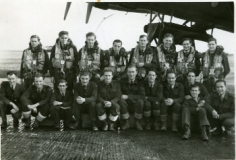 However, when bending down he must have pulled his intercom plug slightly out of the socket, so there was no connection to other crew members. Having seen the open hatch and being unable to communicate with anyone, he assumed that we had all jumped, and quickly followed suit. We were given to understand that he landed in Walthamstow and his parachute had caught on some railings, leaving him suspended a foot or tow above the ground. He was arrested by the Home Guard, but after establishing his identity, was returned to the station.”
Other stories of Roy’s can be read here. And many other stories you can read on this page of the BBC site.
These war memories are so important to have, so that past history is not lost forever. After all, history is made by each one of us, not just politicians and famous people. That’s why my mom, Joan Wehlen Morrison, was an oral historian. The words and stories of everyday people constitute our communal history. Be sure to write down your own story or record the memories of older folks for posterity!
Thanks for sharing, Pete and Roy! I’d like to dedicate this post to Roy who is ill and wish him a speedy recovery.
Women Cryptographers in World War II
An article in the Austin American-Statesman by Ken Herman tells the wonderful story of two women cryptographers in World War II. What did cryptographers do? They had to put messages into code so that the enemy wouldn’t be able to understand. Helen Nibouar, now 91, is quoted as saying, ““I have to admit I was a little frightened, just thinking how important that was and how responsible I had to be.” She and her fellow cryptographer and friend, Marion Johnson (now 95!!!), were honored in November 2012 at the National Security Agency‘s National Cryptologic Museum in Fort Meade, Maryland.
Here is a picture of Helen today.

- Helen Nibouar, age 91, in an article from the Austin American-Statesman, November 2, 2012 by Ken Herman
Nibouar is quoted as being “shocked” that anyone would be interested in what she did during wartime.
Oh, but how fascinating what she and other women and men did during the war! Especially important are the legions of “unknown” people who worked for the war effort. All such stories are valuable, indeed invaluable, for the historical record. Thank you, Helen and Marion, and the countless others, for all you’ve done!
Here is the Enigma Machine at the National Cryptologic Museum. To learn how it works, click here.

The Enigma Machine at the National Cryptologic Musuem
And, if you are equally intrigued by the concept of the National Cryptologic Museum, check out this page where you can download documents from the World War II era about cipher machines, Western Communication Intelligence and the Holocaust, and Woman and Cryptology, among other fascinating and important topics. Here there is more about Women and Cryptology.
And be sure to check out my post on Carrier Pigeons who carried coded messages during World War II–and before and since!
World War II Carrier Pigeon Mystery: Can you crack the code?
There are always new things discovered about World War II. I am so lucky to have found my mother’s diaries from 1937-43 and have published them as Home Front Girl: A Diary of Love, Literature and Growing Up in Wartime America. But a diary is not so odd as the skeleton of a carrier pigeon!!!
Yes, The New York Times recently reported how a bird skeleton with a coded message has been found in England!

- A chimney in a home in Surrey, England, was found in 1982 to hold the remains of a carrier pigeon bearing a World War II coded message. An effort is now under way to find out what it says. From Alan Cowell’s article in The New York Times, November 2, 2012.
As Alan Cowell reports, the skeleton was found in a chimney between “the site of the Allied landing at the Normandy beaches in 1944 and a famous code-breaking center north of London at Bletchley Park.” Bletchley Park is famous as the site of top-secret code breaking activities. Read its wartime history here. The pigeon’s message has not yet been decoded, but it is being worked on! How wonderful to have this mystery still to tantalize us.
But how valiant the pigeon, 40TW194, was! And its message still cannot be decoded. See the discussion of the problems decoding this message here. You can help to crack the code, by reading the message here and below.
AOAKN HVPKD FNFJW YIDDC
RQXSR DJHFP GOVFN MIAPX
PABUZ WYYNP CMPNW HJRZH
NLXKG MEMKK ONOIB AKEEQ
WAOTA RBQRH DJOFM TPZEH
LKXGH RGGHT JRZCQ FNKTQ
KLDTS FQIRW AOAKN 27 1525/6
If you figure this out, contact the UK Government Communications Headquarters.
Carrier pigeons have a long and esteemed history, starting with Noah’s release of a pigeon after the flood. They’ve been used by ancient Romans, Genghis Khan, and in the Siege of Paris in 1870. In World War I, the Germans even strapped cameras to their bellies to take reconnaissance photos until planes took over that duty. By the end of WWI, France had mobilized 30,000 pigeons for war duty!
This article by Mary Blume gives more heroic details, but I must report this heart-rending detail here: “[A] brave French pigeon named Le Vaillant was awarded the Ordre de la Nation…Cher Ami, the equally heroic American Black Check Cock carrier pigeon [, who was one] of 600 birds flown by the U.S. Army Signal Corps, … saved the lives of the 77th Infantry Division’s ‘lost battalion’ at Verdun by delivering 12 messages and returning to his loft with a shattered leg after he was shot. He won the Croix de Guerre with Palm and died in 1919 as a result of his wounds.”

Here is Cher Ami (Dear Friend) on display at the Smithsonian Musuem
Imagine, winning a medal! And the Musée de la Poste in Paris has more information about these brave avian aviators.
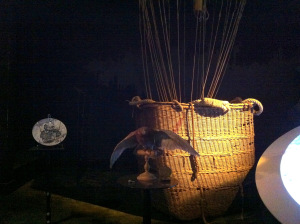
- From the Musée de la Poste. Source: http://parispigeonpost.wordpress.com/2011/04/19/musee-de-la-poste-and-birds-at-paris-station/
You can read more about Paris and the Siege of 1870 and pigeons here. And be sure to check out my upcoming post on Women Cryptographers in World War II.
Giving Quarter
My parents liked to joke. Not in a mean manner — more a sly way, with a wink, causing me to giggle. A tradition developed, one whose origins are shrouded in mystery, as follows:
Whenever I achieved something “wonderful” — for example, graduating with my Ph.D. or publishing my first book — I’d receive a quarter. Yes, an entire shiny coin, usually taped to an index card with some slightly sardonic comment: “For your first published article, Love, M.O.M. and D.O.D.”
In one famous example, I got single quarter for the year I got tenure AND my first book coming out, for which — I jokingly complained — I deserved two quarters!
Now I guess to need to explain “M.O.M” and “D.O.D.”
“M.O.M” was for “Mean Old Mom.” She often signed this way to all us kids which caused merriment because she WASN’T a “Mean Old Mom.” The opposite in fact. But this was our funny way of acknowledging how nice she was. Irony pervades our existence.
“D.O.D.”, on the other hand, stood for “Dear Old Dad.” Now Daddy was not mean, but sometimes curmudgeonly in a self-aware way (he was proud of it!), so D.O.D. was also meant somewhat sarcastically.
And only in editing my mother’s journals did I discover (perhaps) whence this tradition came.
Freya’s Day Dec. 16, 1938
Yesterday I had to give my talk in Readings in World Cultures on an analysis of a biography. I chose Samuel Clemens’ Joan of Arc. I read the book four years ago and neglected to completely re-read it. Nevertheless, I got along all right and when done Mr. Denton says, “Any comments?” Now almost all class comments are derogatory and, when three hands went up, I shivered. Imagine my surprise when Carl Christ said, “I think it was very good etc.” And—the other two agreed! Then Mr. Denton says, “A very good analysis, Jo-anne!” and I went back to my seat. On the way back, Barbara Smith threw a quarter at me (my quarter at that—which she had basely taken at lunch!!!) and Mr. Denton says, “Oh, I think it’s worth more than that.” So. So…”
Is this the original moment, the Ur-event which trickles down to our family today?
Now, with my parents’ passing, who would give me a quarter for my achievements?
Later in the evening, after the first authors’ books — the first hard copies of Home Front Girl: A Diary of Love, Literature, and Growing Up in Wartime America — had arrived, my husband, Jim, went to the study. He returned with this for me:

A quarter from Jim for Home Front Girl–carrying on a Morrison family tradition
“Giving quarter”–a military term meaning to show compassion to a prisoner of war. Here, the visible sign of Jim showing compassion to me, defeated in grief at my parents’ deaths–the quarter of consolation.
Thanksgiving 1938 and 2012
I have a lot to be thankful for. After my parents died, I was so sad. But we found my mom’s diaries, poetry, and short stories in a file cabinet. It was, unbeknownst to her, a gift to us. It contains so many poignant moments in her reflections on the impending war.
Even though my mom came from a working class family, her parents were always able to put food on the table, reminiscent of Norman Rockwell’s famous depiction of Freedom from Want from 1943.
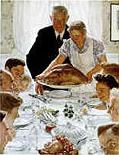
Norman Rockwell’s Freedom From Want, 1943
Five years before that iconic painting, Joan writes about Thanksgiving. She always had a sense of humor–about herself most of all! Here is an entry from Thanksgiving Day, Thursday, November 24, 1938. Joan is 15 years old.
Then we had Thanksgiving dinner and spent afternoon and evening fooling around and pretending we were cave men having to talk in sign language punctuated by grunts (my idea—effect of Humanities). (Remember when we played Kentucky mountaineer and King Alfred and Lady Guinevere?) Well, Daddy was Chief Mud-in-the-Face, Mom was Lump of Fat, and I was Blockhead (later the Sylph-like Faun). Well, so goeth Thanksgiving. . . .
I love how she and her family were able to still playact when she was a teenager!
I’m also grateful to the generosity of people in Austin. On Sunday, November 18, 2012, I gave my first public reading of Home Front Girl at BookWoman in Austin, Texas.
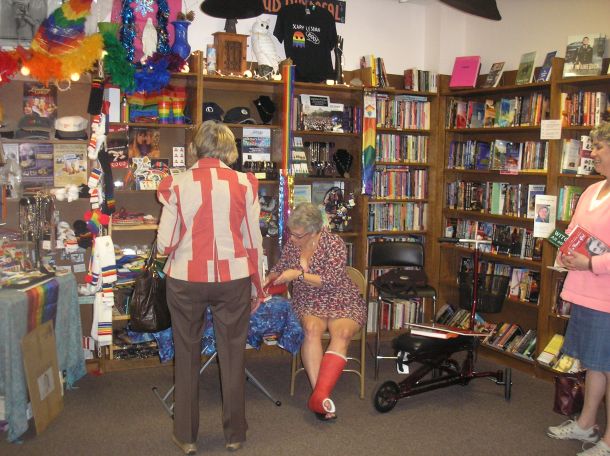
Signing a book for my colleague, Nancy Grayson, at BookWoman. Note the snazzy red cast on my left foot!
Dear friends and colleagues came and it was a fun event.
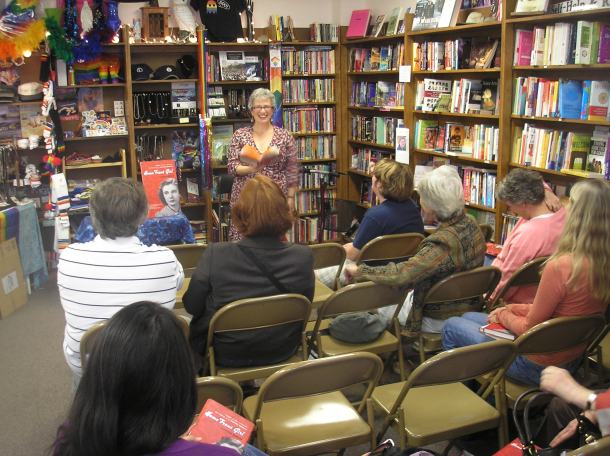
Reading to a crowd of kindred spirits at BookWoman
The Militant Recommender: Review of Home Front Girl
I love this blog that reviews books–and not only because it gave Home Front Girl a lovely review you can read in its entirety here. I like it because it’s, well, “militant.” I will read what ever Stephanie Piro tells me to read! After all, she is in command as the Militant Recommender.

The Militant Recommender at http://militantrecommender.blogspot.com/2012/11/home-front-girl-diary-of-girl-historian.html
I guess that’s what appeals to me about her reviews. Books should be seen as being vital and compelling–we need to read to be aware, happy, and tuned into our world and what’s beyond our world–and to listen in our minds and hearts. Her blog also has adorable cartoons. See the cartoon for Home Front Girl at the end of this post.
Here’s a quote from Stephanie’s review: “It often seems a slower, sweeter time. Joan walking home from a trip to the Art Institute and the library where she borrows a work by Kipling and writes: “Walked home along the lovely lake with elongated purple shadows along the sands. Still bright haired children playing. Still flowers no less vivid or sky less blue, sun like blood in the West. Oh, I felt the glory and the spring of Kipling’s poem, “But as the faithful years return and hearts undaunted sing again”. Isn’t that a lovely thought- “hearts undaunted sing again”-though ever the years are long and hard-the Spring will always come and our hearts can sing again- oh how beautiful”
Is that not more beautiful than a text? She wrote this in 1937, when she was 14….[Joan] writes a multitude of observances on the boys who come and go through her school years, many funny, some angry and others poignant. ….Joan is afraid of what the impending war will do to her life and that of her friends. She is a pacifist, which seems unusual for those times, and has many thoughts on what war does to the people of the USA and the other countries affected. I could go on and on, because this book is just so quotable… but really, you want to get a copy of Home Front Girl for yourself so you can curl up with it and let Joan take you back in time, as you see the world through the eyes of this appealing narrator.”
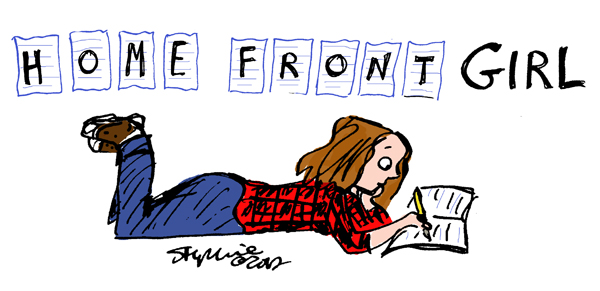
Stephanie Piro’s cartoon of Home Front Girl from The Militant Recommender [http://militantrecommender.blogspot.com/]

 Home Front Girl