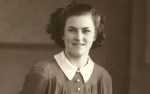
Jim’s requests for schoolgirl photos go unnoticed or at least unremarked upon by Norah and they settle into a fun and flirtatious correspondence through the summer of 1941. For now, there are no more worrying letters, just the complicating factor that is Danny, Jim’s younger brother, who is now on the scene.
Remember it is Jim who first puts Norah and Danny in touch. A trainee officer in the RAF, Danny is on a course at Loughborough College, the Leicestershire town where Norah has just finished her schooling. Jim arranges their first meeting for the 5th July, but Danny fails to turn up. The following week he sends Norah a ‘beautiful letter’, informing her that he is going to a RAF base in Wiltshire. He writes again from there, another grand letter, to say he is going home for seven days (‘on a motorbike’, Norah adds). 30th July: Went to Forester’s Sale. Ma bought coal bucket etc. Received letter…
Here is more about Norah, Joan’s English “twin”–whose diary has recently been found. It provides insight into World War II on the home front–and we hear about the adventures of “dearest dimples”…..
After a difficult few months with very little time in which to write, I now have space ahead of me in which Norah’s story can unfold at the pace it requires.
We are now well-acquainted with our feisty schoolgirl heroine. We have seen her at home – a loving daughter, a squabbling sister, living from the summer of 1938 in a brand new council house in a village in the English East Midlands. We have met most of her family: her gentle mother Milly, bellicose father Tom, her married sister Helen and little niece Jeannie, and older brothers Birdy and Frank.
From one of her contemporaries, we have learned about her life as a scholarship girl at Loughborough High School and have witnessed a whole lot of schoolgirl giddyness in her diaries. We have noted her interests: reading novels and Picturegoer magazine, walking, blackberrying and mushrooming in the nearby…
This past week we have read a lot about the commemoration of the 70th anniversary of D-Day. The coverage on the BBC is well worth visiting.
Commemorative flights.
On June 6, 1944, Allied troops began the invasion of continental Europe on the beaches of Normandy.
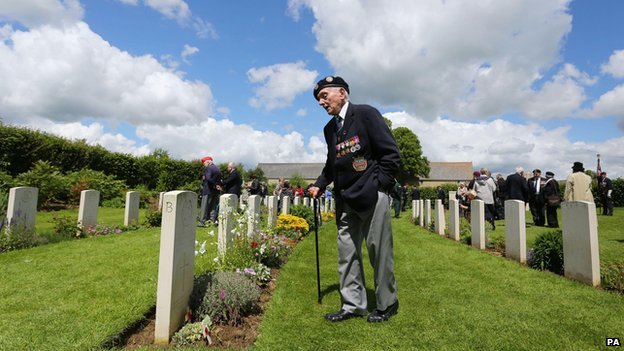
British veteran at a British cemetery.
So many killed.
6 years before D-Day, Joan wrote about the prospect of war and the fate of so many boys she knew. Here is her diary entry from when she was only 15 years old.
Sunday, February 13, 1938
. . . The United States (mine), England and France—the three great democracies as the paper glaringly puts it—sent a note to Japan last week demanding that she cut down on her navies—and yesterday the note came back with an answer—“Go to it—let’s have a naval race”—or to the point. And then Thursday night they had a program on the radio discussing the next war in confident tones. Somehow everything seems to point to 1940 as the turning point—as the time when the climax is reached. Everyone seems sure that there will be a war soon. I was talking to a boy in school Friday about war and death. He seemed sure that there’d be another war (another, oh!) and he said he’d probably be killed in it. All the boys I know will be old enough to die in a war in 1940. When I said, “And afterwards—?”, he said, “Well, if there’s anything to see—afterwards—I’ll see it, and if not, well, I won’t know about it.” Which is, after all, the only thing to say. But think 1940—death—war—oh, why must it be?
The boys she knew did enter the war. Some returned.
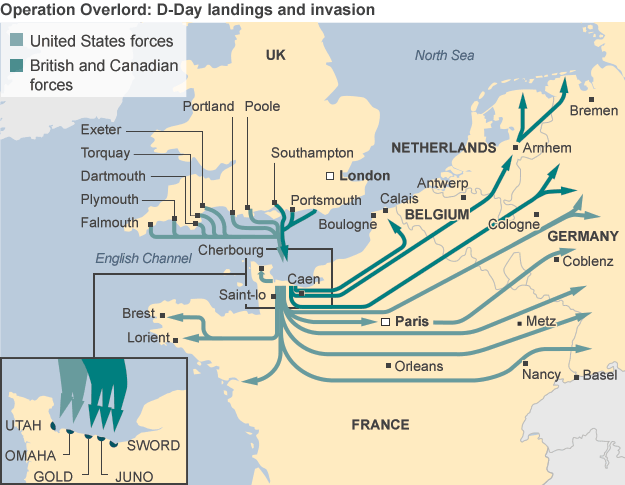
Operation Overlord, now known as D-Day.
But many boys didn’t come back, caught up in battles in the Atlantic, the Pacific, on islands, on the European and North African continents.
Joan wrote a poem when she 18, before the U.S. was even officially at war. She imagines the death of someone she knew. The anguish is as fresh now as it was then.
May 6 – 1941
On reading the papers
I never thought that you could die
I always thought you were
Invincible.
Even in war, I pictured you
Eating bread and cheese in a mud hole
And talking about girls and Plato
With one of the friends you always seemed to find.
I never took war seriously for you;
You never took anything seriously.
Sometimes I fancied you drinking beer
And singing in some canteen; you had a loud voice
And always smiling with the world, or laughing at it.
I don’t know; I never thought you’d die.
You were the kind to take so much the easy way.
I could see you getting acquainted with 20 pretty girls
In 20 tiny provinces.
And though I sent you some badly knitted socks
And one scarf I spent months on (I’m sure
You gave them all away), I didn’t think much of you
Knowing what happens on the home front is important in any war. How can we justly and accurately assess the historical past during wartime without thinking about the situation on the home front?
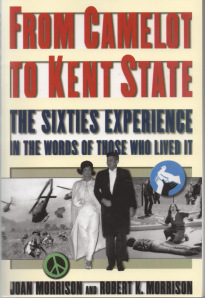
My dear friend, Pamela Neville-Sington, pointed out something I’d never considered before. “Your mom recorded the history of two home fronts: World War II with Home Front Girland Vietnam.”
In that book, they record the stories of Civil Rights activists, Vietnam vets, women active in the women’s movement, campus activists, and people in the SDS [Students for a Democratic Society], Weathermen, and Black Panthers. Additionally, there is an entire section entitled, “The War at Home.” As they write in their foreward, the book is an attempt “to give some idea of what it was like to be living then, to add a human dimension to the black headlines and shocking scenes of those years.”
I think that’s what Home Front Girl shows too: for the young Joan, the home front did not start on December 7, 1941, with the bombing of Pearl Harbor. It already began after World War I, the so-called “Great War,” and never let up until a “hot war” with bullets being shot recommenced.
I see Joan’s diaries as her oral history from the late 1930s and early 1940s. Her interviewing career started when she was a teenager.
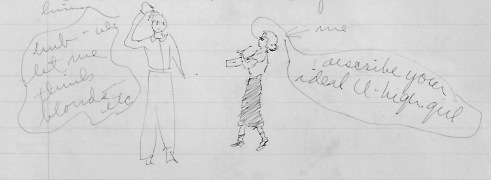
Once she starts at sophisticated U-High (connected to the University of Chicago), interviewing is not exactly what she expected.
Joan’s interviewing a callow youth.
Wednesday, November 9, 1938
I got to school early this morning. . . . I planted myself in front hall and pounced on everyone who came in saying, “Describe your ideal U-High girl” . . . One of them wanted a “glamorous blonde with a slinky walk.” Hmmmm.
She worked with Frances Perkins, who later become Franklin Roosevelt’s secretary of labor, to improve conditions for laborers. She ultimately took the role of educational director for the International Ladies’ Garment Workers’ Union Health Center, knew Eleanor Roosevelt, and consulted with the U.S. Public Health Service.
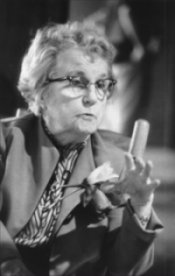
Pauline Newman
One family joke is that my mom interviewed Pauline Newman twenty times in NYC, when in reality it must have only been twice. Why this overblown reckoning?
My children chastise me that I never went to high school. That isn’t true. What is true is that during my high school years, Joan had to go to New York periodically to interview various people, not just Pauline Newman. We lived in Morristown, NJ, about one hour from New York. So my dad and mom and I would drive in about 1:00 in the afternoon to “the city.” While my mom conducted her interviews, Daddy and I would indulge in our favorite: double features of old movies at various movie houses in Manhattan.
Carnegie Hall Cinema
Then we’d meet Mom for dinner (the Copehagen, anyone?) and drive home.
But to get to New York in time for the cinema and interviews, I had to miss school. My parents would shamelessly write letters excusing me from school to see the “dentist.” I must have gone to the “dentist” more than anyone else at Morristown High School in the mid-1970s. I’m not sure the administrators caught on. And I did fine in school despite my dental “woes” (aka cinematic delights). Surely only one or two of my illicit trips to NYC with my parents involved the notorious Pauline Newman interview!
Recently, I found Pauline Newman’s voice. Imagine how shocked I was to find…my mother’s voice too. My dead mother suddenly speaking there. It was so eerie–and beautiful. Here is Joan’s interview with Pauline, made in the late 1970s.
When Jim’s letters fail to arrive at the end of April 1941, Norah’s disappointment soon spirals into high anxiety. She hears on the wireless that his ship, HMS Elgin, has been under fire from enemy aircraft. She seems not to know at this point in time that there were no casualties among the crew. All she has at her disposal is the information that some of his shipmates have brought down a Heinkel and her imagination of the horrors involved.
London Gazette, 29 April 1941
Norah will have heard on the news about ships around Britain that had been bombed, damaged, blown up or sunk. In that week in April alone, one ship in a convoy near Cromer went down, as did an anti-aircraft vessel off the Tyne. HMS Raleigh took a direct hit at Portsmouth, leaving 42 dead and 13 injured. A minesweeper off Millford Haven was ‘mined and sunk with all hands lost’.
Today is International Workers’ Day. I always celebrate it, even though it isn’t a big holiday in the United States. I wish it were.
Joan’s father was a socialist. The son of a farmer and an immigrant from Sweden, Werner Wehlen came to Canada and then the United States to make a better life from himself.
Joan’s father, Werner Wehlen, at age 87 after his first ride in an airplane to San Diego, California.
He didn’t want to remain beholden to the lord who owned the land his father worked on. “I remember my grandfather, and even my father, having to [work for a feudal baron] every year on the private domain where the lord of our land lived.” [1]
Werner certainly exposed Joan to his socialist leanings which were especially pronounced during the hard times of the Depression. One Saturday, he took her to Bughouse Square. [2]
Tuesday, June 7, 1938, Age 15
. . . Sunday night Daddy and I went to Bughouse Square. Not many talkers there and those not as good as they could have been. One of them was talking anti-everything and while he talked, I saw Venus shining over his shoulder. They say she is blue, but that night she was quite golden. And the man talked, sharply silhouetted against the street lamp, standing on his soapbox, the crowd like some dark elemental mass crowded below him and the great golden orb of Venus over his shoulder. The church spire in the East pierced the sky like a black rapier and the Newberry Library was a gloomy disapproving bulb in the night. It was a picture to take with you, unreal with the insects buzzing in the light and the trees moving like shadows in the warm night. Rain fell for a minute like a canvas over an unreal picture. Grant that I may know more unreal nights like that, when one can half-close one’s eyes and seem not to exist at all save as a watcher. Home and the sky was purple.
Joan even jokes about being mistaken for a radical.
Monday, April 19, 1937, Age 14
Mr. Lucas thinks I’m a communist. Today in Study, you see, Ruth and I were—well—you know—doing Latin together. Which isn’t approved of. Then Alice asked me what onomatopoeia is and, while I was explaining, Mr. L. came over and said, “Can’t you work by yourself?” to me. “Are you helping these girls or are they helping you?” And I said, “Well, it’s sort of community work, you see.” And he said, “Well, you know we can’t have a lot of little communities in study hall.” And I said, thinking of Latin, “No, but why not one big community.” I guess he must have thought I was a communist then, ’cause he looked sort of frightened and said we’d better work alone. And I said, “Uh-huh.” And that was that. Once before he made me (and Ruth) stand in the corner for community work—me the socialist! And I had my red sweater on, too!
Maybe Mr. Lucas thought she was going to break out into singing the “Internationale,” the unofficial hymn of workers the world over.
The lyrics are:
Arise, the workers of all nations!
Arise, oppressed of the earth!
For justice thunders condemnation:
A better world’s in birth!
No more tradition’s chains shall bind us,
Arise, you slaves, no more in thrall!
The earth will rise on new foundations:
We, who were nothing, shall be all!
Forward, brothers and sisters,
And the last fight let us face;
The Internationale
Unites the human race!
Forward, brothers and sisters,
And the last fight let us face;
The Internationale
Unites the human race!
Here is Arturo Toscanini conducting a banned version of the “Internationale.”
Joan later enacted her socialist beliefs by becoming an oral historian who records the voices of real, everyday people. I’ll write about that more on Mother’s Day this year.
The tradition of oral history lives on. My son, John, had a project in school involving oral history. They had to read, edit, and perform an interview undertaken by Studs Terkel, the great oral historian. He was a trailblazer in the field and a great inspiration to Joan in her work.
John chose to perform the story of Florence Reese, an old, tough-talking grandma.
Florence Reese
She was also a trailblazer for workers’ rights.
She was an amazing woman whose family of miners suffered from the cruelties inflicted by the mining companies and the U.S. government in the 1930s. But she is famous for having written a song, “Which Side are you on?”, that became a rallying cry for oppressed workers everywhere. Here it is sung by Pete Seeger.
And here is Florence herself singing the song.
We should all reflect on this in the wake of the financial crisis of 2008 and great economic disparity that exists today.
[1] Joan Morrison and Charlotte Fox Zabusky. American Mosaic: The Immigrant Experience in the Words of Those Who Lived It. Pittsburgh: U of Pittsburgh Press, 1980/1993, 3.
[2] A nickname for Washington Square Park. Anyone could speak to crowds there, generally on soap boxes.
Joan and her pal Dorothy used to make up poetry together. Here’s one of their less successful but more amusing efforts.
Joan on March 1, 1939. Doesn’t she look swanky?
Monday March 12, 1939, Age 16
…. [A]s Dorothy was at typewriter and wanted to write, I decided to make up a super-modern poem so we did…Dorothy types by the hand-finger-search-method, much as I think and so we got along fine—for a while…it was super modern and I dictated lots of dots and no capitals…here is how it went….
tests…..
i hate them…
brutal, inhuman, repulsive, lowly…
my soul shrieks discreetly….
RELEASE…RELEASE
i am a goldfish in a deep grey ocean
tests are quicksand..they are eating away my soul…
horrible, ghoulish, suffocating…
….confidentially….they
….STINK.
Isn’t it beautiful….I think so. When we were done, Fraser sang out Iliadically, “Sing, Goddess,etc.” and I got up on a table to enunciate. When Barbara shouts joyfully, “Oh, good afternoon, Mr. Jacobsen” and I leapt unagilely down. Bang…and read it from the floor…to much applause.
I wanted to call it a poem in very blank verse but Fraser said then it would have to be in unrhymed iambic pentameter so I didn’t…Anyhow, it was well received and we put it up on the bulletin board entitled “Poem in the Very Modern Manner.” Rick didn’t quite understand the “goldfish” line:
Says he: “But goldfish don’t live in the ocean—“
Says I: “Well, that’s the idea—I’m out of my element.”
He: “O you’re marvelous …You ought to do something about that.”
Me: “I shall…”
Oh, but that was cute. Me standing on the table sprouting poetry.
Joan spouting poetry
Much fun was had by all.
Now, I’m sure Joan would be the first to agree that this poem is not, shall we say, of Shakespearean quality. But she and Dorothy had a fine collaboration and enjoyed themselves. Plus gave joy to others. Women in cahoots with each other–a theme in so many women’s lives.
Women helping women was the theme recently for me at the Story Circle Network Conference, a wonderful event that occurs every two years. Women writing life stories and memoirs gather, sharing their stories and techniques for producing heart-felt, passionate, funny, and moving stories from their lives and the lives of women they know.
Perhaps the most moving moment for me was when young Joan was honored by one of the presenters as her mentor in the field of oral history. Carole Garibaldi Rogers, the journalist, oral historian, and poet — and an old friend of my family — presented on From Census to Story: Bringing a Family Tree to Life.
Carole Garibaldi Rogers, a dear friend and Joan’s wonderful writing colleague
As she introduced her material, she explained how my mother Joan, a long-time member of the same writing group with Carole, had been a nurturing mentor in the field of oral history.
Susie with Carole Rogers. Photo by Laura Cottam Sajbel.
Women helping women– over the decades and over millennia.
At the conference, I presented on From Family Documents to Published Book and shared tips from my learning process for Home Front Girl. One student had masses of oral history material. How to cut it down?
I cited, as always, my mom. Joan had said concerning her oral history interviews that there is always a story in the transcript. You have to create a short story out of that material and make it glow. Sometimes the person telling the story does not realize what the narrative arc of her own life is until she starts telling her tale. Maybe it is only the editor who polishes it into a coherent narrative. As I said, “I always listen to my mother.”
Susie teaching a workshop at the Story Circle conference. Thanks to Sallie Moffat for taking photos.
I’ve been blessed with many mentors–at Story Circle, Susan Wittig Albert, the amazing creator of the group, generous with wisdom and warm support.
Susan Wittig Albert, generous dynamo and writer extraordinaire
Recently, the New York Times reported about a couple who collect memorabilia from the 1939 New York World Fair. You can read the entire article here.
Dr. Roy Goldberg at left and Keith Sherman at the right next to their plaster model of a statue from the 1939 World’s Fair in Queens. Credit James Estrin/The New York Times.
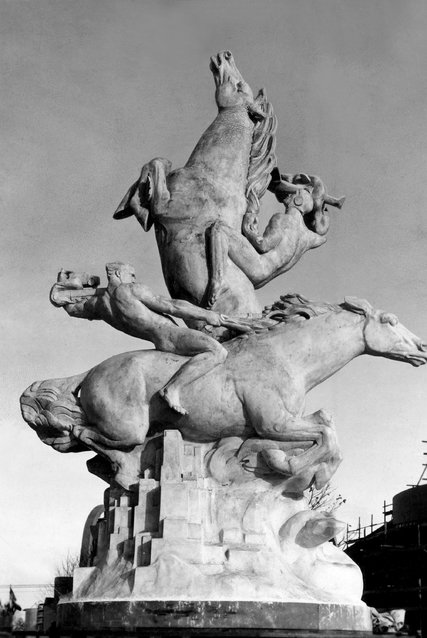
Dr. Roy Goldberg and Keith Sherman collect everything from menus to scrapbooks to posters. Even a plaster model of a statue shown at the Fair! The original, full-sized statue, “Riders of the Elements,” stood on the Avenue of Transportation.
“Riders of the Elements” at the 1939 New York World’s Fair
The Times quotes Louise Weinberg, the manager of the archives at the Queens Museum concerning the style of such sculptures. “It was of its time and, I think, futuristic….It was in the genre of many of the other sculptures that were done at the time. They grew out of futurism and Art Deco and a streamlined style. They were rooted in traditional sculptural ideas, but they were far-reaching in their aspirations. It was all about building the world of tomorrow, which was the theme of the fair.”
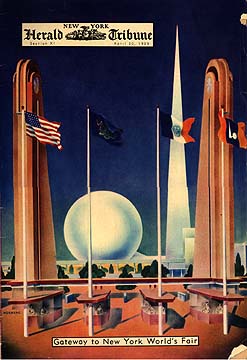
Poster advertising the Fair
The Fair opened 0n April 30, 1939. In this video clip, Franklin Delano Roosevelt opens the Fair, aware of the world’s political tensions.
Unlike the eyewitness in that clip, Joan clearly saw how the war influenced the New York World’s Fair in 1939 which she visited the week World War II began in Europe. She had spent the summer at camp. The Fair was advertised to young people as an especially appealing way to learn.
Joan would graduate from high school in 1940.
This photo was taken the day the Germans crossed into Poland–only when the photo was snapped, no one in the countryside of Michigan was aware that the violence had begun.
Joan at summer camp on September 1, 1939. You can she wrote exclamation marks after the date.
I have been reading about the [World War I] dead and am thinking how awful it must be for a mother—or a father—to know their grown son dead. After bearing and bringing through childhood to the prime of his life a son—to find that all this is futile, that all this is ended—all vain. That he died before he began to be himself. To lose a child must be in a deep sense far worse than to lose a husband. It must make one lose the sense of continuity. . . . A husband dead means that you are, in a way, dead—but to lose a child means you lose immortality—that you shall not go on. . . .
[1] Ironically, Joan wrote this entry before she knew World War II had begun on this day.
The futuristic style of the Fair is reminiscent of another 1939 classic: The Wizard of Oz.
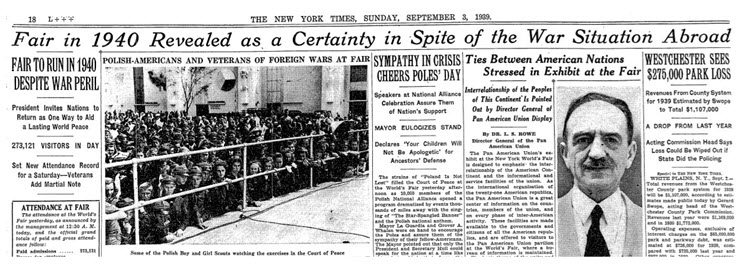
Then she and her mother take the train to New York to visit the World’s Fair. This Fair Newspaper from Monday, September 4, 1939 tells what happened at the fair on the day Joan writes the poem below. If you look at the articles in that link, you can see that museums like the Louvre in Paris, National Gallery in London, and Rijksmuseum in Amsterdam ask the Fair to keep the treasures lent for the duration of the Fair until further instruction. The museums fear for the safety of their treasures should they be returned to a Europe at war. To read much more about how the Fair became politicized, read this fascinating piece here.
Article from the first week of World War II, showing how the Fair reflected the world’s turmoil.
While at the World’ s Fair, Joan writes this poem, reflecting on the conflagration begun in Europe.
‘Dearest Norah’: as March runs into April, Jim takes the lead in stepping up the level of intimacy with his sixteen year-old correspondent. He teases her with his suggestion that her favourite (unnamed) radio star is chosen purely on account of his good looks, unlike his own choice, Bruce Belfrage, famous for his masculine stiff upper lip, calmly carrying on as the bombs fell on Broadcasting House.
He imagines (wrongly) her hair colour in his cheeky signing off:
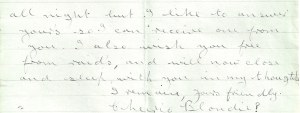
Jim to Norah, 23rd March 1941
‘I try to picture you, Blonde about 5’6”. Please forgive such a short letter but I have been travelling all night but I like to answer your’s so I can receive one from you. I also wish you free from raid’s, and will now close and sleep with you in my thoughts. I remain, yours friendly, Cheerio Blondie? Jim. “Smilin Thro”’.




















 Home Front Girl