RSS Feed

The Interviewer’s Perspective

My mother, Joan, grew up to be an interviewer of many people.  As an oral historian, your sources are people.  People of all walks and stations in life.

Alistair Cooke, the great broadcaster and reporter

Alistair Cooke, the great broadcaster and reporter

Her two co-written books contain dozens of moving stories of everyday people — and some famous like Alistair Cooke, John Lewis

John Lewis, U. S. Representative and Civil Rights Activitist

John Lewis, U. S. Representative and Civil Rights Activitist

and Jerry Rubin.

Rubin speaking at the University at Buffalo in March 1970

Rubin speaking at the University at Buffalo in March 1970

In high school, I remember she and my dad would sometimes take me out of classes early.  We’d drive into New York City so Mom could interview Pauline Newman, who survived the Triangle Shirtwaist Factory Fire of 1911 and grew up to be a famous union organizer with the International Ladies Garment Workers’ Union.  Other times we drove in so she could interview other sources for her book.  While she interviewed, my dad and I saw double features of old movies from the 1930s and 1940s at art houses like the Little Carnegie Playhouse, the Thalia, or Bleeker Street Cinema.  Afterwards, we’d meet my mom and eat at the now defunct Copenhagen restaurant for herring and smorgasbord or pasta at Minetta Tavern in the Village.

logoJoan’s interviewing skills started in high school when she ran the Vox Populi (Voice of the People) column for the school newspaper.

Monday, November 14, 1938

. . . After lunch I went to teachers’ lunchroom to ask questions for “Vox Pop”—“What’s your idea of an ideal pupil?”—teachers all male. Mr. Heaton says one who brings apples every morning. I shall remember that sometime. Mr. Trumpell asked me if I wrote the column every week—he said he got a kick out of it—especially my terse remarks, says he. (I looked up “terse” in the dictionary; it means, “elegantly and forcefully concise”—that’s me!). . . . I had to get my picture taken for Cosmopolites[1] today. Sorta sickly smile on face of all.

[1] Evidently a club for those who are cosmopolitan.

November 14, 1938.  Doodle by Joan of her class and teacher laughing at her trying to find Volume 1 (not 2) of Thucydides.  She has lost a tooth.

November 14, 1938

This interview has unexpected — or perhaps not! — consequences!

Monday, November 21, 1938

And then today—oh, today was a lovely day. In the morning from the L, the world was real and tangible in the bright air and the sunlight. Then when I got to school (one minute on time), the boy behind me started to tell me how what Mr. Heaton said for my column brought results—You know for his “ideal pupil,” he said one who brings apples every day. Well, it seemed every one in the school took the hint, for there was Mr. H. with apples, apples, apples of all kinds on his desk—big, little, even one with a ribbon on it. Well, it proves someone reads the column, as my editor cynically said. In the middle of the class during organization paper writing, Mr. Heaton came up to me and said, “Well, I suppose you want your share of the loot.” And I said, “Oh, of course! I expect my commission.” And he grinned and said to take my pick. So at lunchtime Bobby Smith and I went up and took some big red apples while Mr. Heaton grinned (he’s so cute!) and Richard Schindler looked puzzled. As I explained, it will stop the Depression—fruit stores sell more, pupils get A’s, Mr. Heaton gets fat and I get my commission.


Once she starts at sophisticated U-High (connected to the University of Chicago), interviewing is not exactly what she expected.

November 9, 1938

November 9, 1938

Wednesday, November 9, 1938

I got to school early this morning. . . . I planted myself in front hall and pounced on everyone who came in saying, “Describe your ideal U-High girl” . . . One of them wanted a “glamorous blonde with a slinky walk.” Hmmmm.

I think my mom found that boy quite amusing!

November 14, 1938. Doodle by Joan of her class and teacher laughing at her trying to find Volume 1 (not 2) of Thucydides. She has lost a tooth.

November 14, 1938. Doodle by Joan of her class and teacher laughing at her trying to find Volume 1 (not 2) of Thucydides. She has lost a tooth.

Speaking of interviews, I’ve had the good fortune to have been interviewed by lovely people since Home Front Girl came out.

Trilla Pando’s lovely review of Home Front Girl came out a while back. But I just came across Trilla’s blog describing how she got into reading it. It’s really fun!

“[B]eing a reviewer for Story Circle Book brought me just what I needed! Home Front Girl: A Diary of Love, Literature, and Growing Up in Wartime America appeared at the front door as if on cue. I’ve been journaller about as long as I can remember. A one-year diary showed up under the Christmas tree every year with the same dependability as the doll at top of the red stocking, and continued even after the dolls went away. I made my most recent entry this morning. Part of my life. I was ready, ready for this book.

Joan Wehlen Morrison was a greater journaller than I. What’s more, while I assume “no one’s ever going to care about these” and store them helter-skelter and here-and-there, Joan wrote thinking that her journals would be read, stored them carefully, and made sure her writer daughter knew where they were.  That daughter, Susan Morrison has turned these journals into a story of both her mother’s life from when she turned 14 in December of 1936 to 1943 when she met her future husband of 66 years. But Morrison has done more. She’s captured a slice, a small slice but an important one, of American history. This is an important book.
Trilla's copy--she writes, "Well read now, and I'll be reading it again."

Trilla’s copy; she writes, “Well read now, and I’ll be reading it again.”

And inspirational to me. My next get-organized is not going to be the mess under the kitchen counter that’s on the schedule now. No. I’m going to take those boxes of disorganized mixed-up journals and diaries and get them in chronological order, and then, I’m going to read them.  It may be that some do indeed need discarding—I’ll do it now, and I’ll be the one to do it. But others I’ll keep and who know, while likely they will never be published, someday great or great-great grandchild may enjoy knowing what twentieth-century life was like in the Panhandle of Texas.

            Thank you Morrisons.”

And thank you, Trilla!
“Dear Diary” on Paper and in the Age of Computers and Social Media

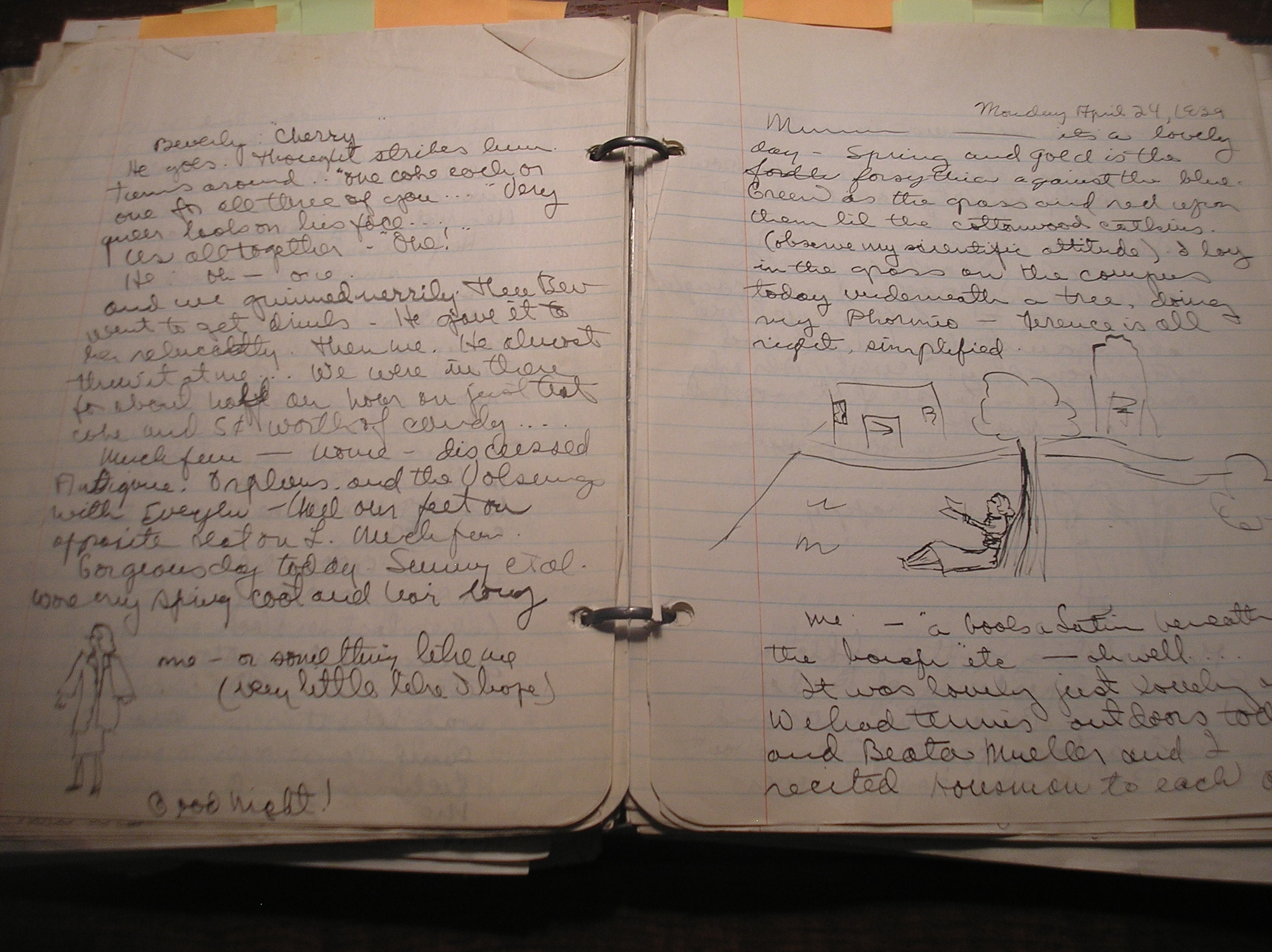
I found my mother’s handwritten diaries after the death, transcribing and editing them into Home Front Girl.  As a professor of English literature, my training made it possible for me to think about what passages I wanted to retain so that the book had a narrative arc.  The published version consists of about 2/5’s of the actual material Joan had written. Joan speculates on the fate of her diary.  On January 20, 1942, Joan hears the Pulitzer-Prize winning author, Stephen Vincent Benét, speak on “Poetry and History” at the University of Chicago.

Monday, April 24, 1939

Monday, April 24, 1939

Stephen Vincent Benét, Yale College B.A., 1919

Stephen Vincent Benét, Yale College B.A., 1919

Joan writes,

Mr. Benét was talking about diaries in history and I believe I have written mine with the intention of having it read someday. As a help, not only to the understanding of my time—but to the understanding of the individual—not as me—but as character development. Things we forget when we grow older—are written here to remind us. A help not only in history but in psychology (I can’t even spell it). If I can do that I believe I shall have done all that I could wish to. I rather like the idea of social archeologist pawing over my relics.

Of course, that is exactly what has happened–only her daughter (me) is the social archeologist.

On Sunday, the New York Times had a piece called “Dear Diary” (scroll down on this link) commenting on how the diary format remains an integral part of the Young Adult and Children’s bestseller lists–with Sherman Alexie‘s The Absolutely True Diary of a Part-Time Indian and the Dork Diaries by Rachel Renee Russell, and Diary of a Wimpy Kid (Jeff Kinney).  Diaries appeal since we sense they are the one spot where an authentic self is revealed.

But what happens today in a world where electronic recordings detail our daily lives?  The New York Times article by Parul Sehgal poses that very question, asking “[H]ow many people actually keep diaries anymore?”

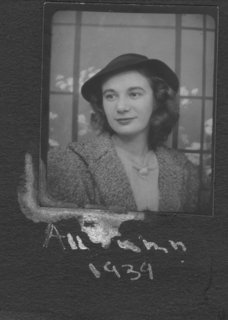
Joan at age 17 when she was keeping her diary.

Joan at age 17 when she was keeping her diary.

Michele Filgate in Salon wonders if social media will kill the diary off.

Nick Harkaway suggests that some diaries were written with the ultimate goal of being published, as with Churchill’s.  The author Brian Morton is quoted in Filgate’s article as saying: “I’ve read that Tolstoy used to keep two diaries, one that he left lying around for other people to read, the other a more intimate record for himself alone.”

Filgate wonders what we are losing with the advent of Facebook and Twitter.  While social media allows writers to instantly connect with their readers, a diary fills a key void for a writer. “Perhaps in this day and age, a diary and social media can serve the same purpose: as a place for writers to be themselves. Yet part of me is intimidated by the idea of sharing all of myself with an audience. The privacy of a good old-fashioned diary for my unfiltered thoughts is incredibly appealing — even though I know that for writers in times past, what was private eventually became public.”

Joan only had two-ring binders; no fancy diary with a lock and key.  Her parents could have read them if had chosen to.  While Joan speculates on the future of her diaries, it is clear she doesn’t want anyone but herself to read them now.  As Filgate writes, “It used to be that many writers’ diaries were published posthumously — and often, passages they might not have intended for the public would be shared with readers.”  Joan’s seems like a private diary–especially given her tales of necking with various boys!

Today NPR had a report called “For Biographers, The Past Is An Open (Electronic) Book” by Ilya Marritz.  A problem for biographers in the future who used to rely on hand-written or typed letters and diaries is that the very medium messages or book drafts are preserved or sent on–computers– are ephemeral.  Marritz writes, “A lot of us think electronic communications live forever. But if someone won’t give up his emails, or takes his passwords with him to the grave, or if he used software that’s now outdated, his records may be lost.”  The biographer of David Foster Wallace, D. T. Max, writes that the loss of some of this material is “a new form of defeat for biographers.”  He even recommends that biographers get training in computer forensics!

Max points out that searchability is a plus with electronic records (should they exist and be accessible).  But, as a scholar, this creates its own concerns.  Home Front Girl is available electronically on Nook or Kindle which is great. You can download it this instant should you choose.  As an author, I’m all for that.  And then you can search for topics that interest you, such as “God” or “Churchill” or “German.”

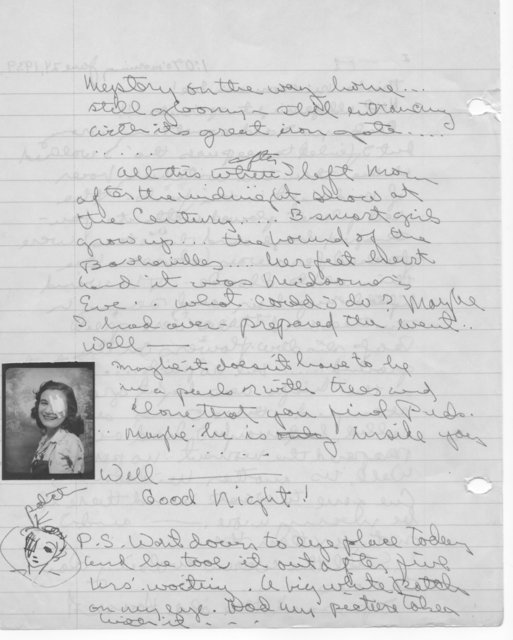
Here Joan writes, makes a little sketch, and pastes in a photo her herself with her injured eye.

Here Joan writes, makes a little sketch, and pastes in a photo of herself with her injured eye.

But (and this is a big but) reading in this way prevents you from seeing the big picture, from experiencing the entire aesthetic impression the book as a whole breathes.  If you only read Shakespeare for words like “blood” or “king” or “wind”–what kind of understanding would you gain of his changing and textured readings of those concepts?  It would be superficial at best.  You need to read a book as a whole before privileging searchability.

Ultimately, for me, as a daughter missing her mother, I found the hand-written diary to be of boundless comfort.  Less impersonal than pixels on a screen, to see her ink blotches from the days of fountain pens and spontaneous drawings was infinitely more intimate than an electronic medium.  In fact, I wrote a piece for This I Believe on the importance of Writing a Diary — on Paper.  As I wrote there, “But nothing can replace the physical presence of the ink trails carefully traced by a human hand. Especially those made by a beloved human hand.”

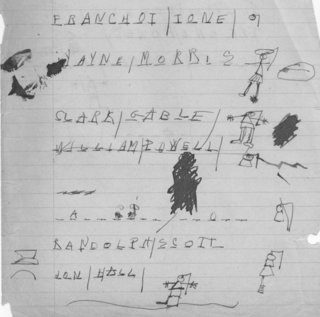
She even includes her hangman games.

Joan even includes her hangman games.

Susan’s interview with Story Circle

I’m so grateful to Trilla Pando for the provocative questions she asked me about creating Home Front Girl.  The interview is now posted here.  I hope you enjoy it!

Story Circle Book Reviews:  reviewing books by, for, and about women

Story Circle Book Reviews: reviewing books by, for, and about women

What did teenage girls read in the 1940s? Beany Malone

My dear friend from junior high and high school, Beth Carroll, told me about a wonderful girl’s book 3 years ago, shortly after my parents died.  The book was Beany Malone by Lenora Mattingly Weber.  I had never heard of it, but she said it was great. And if Beth says a book is good, it is!

The cover of Beany Malone, originally published in 1948; republished by Image Cascade Publishing  in 1999.

The cover of Beany Malone, originally published in 1948; republished by Image Cascade Publishing in 1999.

So I ordered it for my (then 14-year old) daughter, Sarah.  But I only got around to reading it this week.  It’s one of those books you stay up until 1 a.m. to finish.  After everyone was sound asleep, I sat deliciously alone in the living room, propped up by pillow and read every blessed word until the end.  And then I wanted more!!!  And guess what?  It’s a series!  Not only is there Beany Malone, there are 13 other books featuring her and her delightful family.

The first book in the series, Meet the Malones, came out in 1943, while Beany Malone, the one I read and second in the series, appeared in 1948. World War II is still reverberating for this motherless family of four teenaged and twenty-something children.  Beany is the youngest at 16, her brother Johnny is a senior in high school, and Mary Fred is a freshman in college–but having woes finishing up high school chemistry and getting rushed by a sorority.  The oldest child, Elizabeth, is the one most directly affected by the war.  She is 22, the mother of 3-year old Martie.  Her husband, Don, has been overseas.  Just shipped back, he is mysteriously not able to return home.  We soon learn why.

Beanie is always trying to help make people’s lives better–but her generous interference sometimes backfires.  She calls Don at a hospital on the West Coast and pleads with him to return; Elizabeth just can’t bear being without him.  Of course, none of them realize why Don is delaying his return.

Beany is the only one in the household when Don returns at dawn.  “Beany stood there stupidly, her sleep-fogged mind trying to adjust.  Don?  Elizabeth’s Don?  This thin, sick-looking man, hanging shakily onto his crutches?  This wasn’t the erect, broad-shouldered Lieutenant McCallin who had walked down the chapel aisle under crossed swords with Elizabeth.  This wasn’t the pictured Lieutenant McCallin whose eyes twinkled out of the picture on Elizabeth’s dresser.  This was a thin, drained-faced, crippled soldier” (151).

Norbett Rhodes, object of Beany's admiration, and a jar of freckle cream she uses--in vain!

Norbett Rhodes, object of Beany’s admiration, and a jar of freckle removing cream she uses–in vain!

Don has to have his leg amputated below the knee.  When Beany and Mary Fred visit Don in the hospital, they are sobered by the handicapped men they see.  Beany thinks, “‘The war isn’t over for these men. For the rest of you, yes — but not for them.  These are the ones who are still paying'” (174).  Then they see a “small-town boy” with “a metal vise affair that held his neck rigid.”  He waves to them and says, “‘Hiya Babes! If we’d known you were coming, we’d’ve baked a cake.'”  The girls laugh and wave back.

Beany reflects, “The wolf call and the ‘Hiya Babes’ had said better than any words the attitude of American soldiers. ‘We can take it and go on from here.  We still like girls and fun. We’re down, but far from out.’  The two girls, without realizing it, were marveling at the same thing over which all the nations of the world had marveled. At the ability of ‘Yank’ soldiers to wisecrack through thick and thin. At that superabundance of humor which was typical of American men and which carried them through not only the thickness of tragedy, but through the thin monotony of hospital days as well” (174-5).

Lenore Mattingly Weber

Lenore Mattingly Weber

Weber wrote this just after the war, when disabled veterans would have been a common sight.  Not everyone of “The Greatest Generation” made it home–and certainly not everyone came home in one piece.  Surely teenagers were thinking about this–and seeing it in their daily lives.  Perhaps a father, husband, older brother, boyfriend, or cousin had been injured in the war and a girl had to live daily with helping a family member with his injury.  Rather than a sunny, unrealistic view of war, Weber paints a picture realistically, though with a characteristically practical philosophy that is ultimately imbued with optimism.

I’m thrilled that Image Cascade Publishing decided to reprint these wonderful books by Lenore Mattingly Weber. Here is more about Lenore from their website where you can purchase this series or other fascinating girls’ series from the past.

Charming sketch from the series:  from upper left clockwise: housekeeper (?), Johnny, Mary Fred, Martie and his mother Elizabeth, Beanie kneeling down

Charming sketch from the series: from upper left clockwise: housekeeper (?), Johnny, Mary Fred, Martie and his mother Elizabeth, Beanie kneeling down

If you want to know what kinds of things girls read decades before now, this is the series for you!

Let’s give credit to teens! How can Joan be so literate–and literary? Part 2

Someone at a reading said that she knew my mom wrote the entries in Home Front Girl, but it’s so sophisticated, some might not believe it.  I know it is hard to imagine, but she really wrote such beautiful words.  First of all, she came from an intellectual family—although her parents were “working class” or “lower middle class”, they loved poetry and literature.  They met at an adult education school in a poetry class.  So Joan grew up with poetry and valuing it.  Then she loved to read, especially poetry.  She had no tv to distract her. AND she was a writer—worked on the newspaper and wanted to be a writer when she grew up.  All that combined together to make her the perfect observer of the world stage as well as her own private world.

Here is just one of the many beautiful passages Joan writes:

Friday, June 30, 1939

. . . Thursday the 28th was the dinner-dance. . . . I came horribly late to dinner, but ate the ice cream anyhow. . . . It was at the [Hotel Shoreland] at 55th and the Lake. . . .

Joan in blue net hat

Joan in blue net hat

After dinner we went downstairs where they had chartered a room. . . . It was all decorated up—with red and white balloons everywhere and a slippery waxed floor and pictures of the school and copies of the Midway and so forth all over. . . . It was open to Aunt Polly’s farewell address—it made me feel almost sad. . . .

I wore my teal blue dress with the pleated skirt—very sheer stockings—my black suede and gold belt and my black suede pumps!!! You should have seen me. And I just had a permanent so my hair was absurdly short and frivolous looking. . . . And I had my little blue net hat sitting over my curls like an idiotic Juliet.

Joan in autumn 1939
Joan in autumn 1939

Anyhow, it was just wonderful!! Just wonderful!!! They played a radio and some records and Olly asked me to dance. Almost all the boys had dark coats with white flannels like in the movies or the magazines. So we danced for a while and then they opened the French doors and Bill Russell asked me to dance with him and we danced out on the veranda. . . . The trees were waving faintly in the night breeze and we could see the moon over them. The lake was dim and shiny and people came out on the fire escape to watch. Some other couples were dancing out there, too, by then . . . I felt so transferred, so aristocratic, so dream-like—dancing in the night on the veranda of the Parkshore Hotel in Bill Russell’s arms . . . just like in the movies. . . . I remember when I was very young, I thought heaven was a beautiful ballroom with women in light dresses dancing with men in evening dress and that I was a little girl watching them through the French doors from the palms outside. . . . That was my idea of heaven, gleaned, I suppose, from an early movie . . . I don’t know. Anyhow, I thought of that, dancing outside then—and smiled a little for that little girl, watching from the trees. . . .

And that was my flight at aristocracy. . . . Well . . . it’s all over now . . .

The book reminds us how wise young people can be.  We don’t always credit teens or pre-teens with having depth or sophistication and reflection in their thoughts and that’s so wrong!  They deserve credit for having the potential for deep and philosophical reflection, as we see here.

See: How can Joan be so literate-and literary Part I.

New Moon Girls: Girl Created Review of Home Front Girl (also Girl Created!)

My mom was a girl when she created her diary.  One of my favorite magazines is also girl created — New Moon Girls.  It’s a magazine written entirely by girls!  It also has beautiful artwork by kids as well.  I used to get a subscription for my lovely daughter, Sarah, until she moved onto The New Yorker.

Welcome photo for New Moon Girls

Welcome photo for New Moon Girls

New Moon Girls is now an interact social media site with  all sorts of features:  including Changing the World, Body and Feelings, Arts and Culture, and even Games.

Arts and Culture

The magazine is wonderful because is doesn’t succumb to the worst of cultural pandering concerning young women.  Rather, it is respectful, supportive, and challenging in the best way.  As the magazine description states, “Our bi-monthly magazine is 100% advertising-free, highest-quality content for girls age 8 and up! You won’t find diet advice or popularity contests here. New Moon Girls magazine is about helping girls discover and honor their true selves, engage in meaningful pursuits and dialogue, and express their voices in ways that matter.”

Cover of the March/April 2012 edition

Cover of the March/April 2012 edition

It’s an amazing organization — where else can you find a magazine with a “Girls Editorial Board (GEB) made up of girls age 8 and up from the U.S., Canada, and the U.K.”?  Do check out this page with lots of information about Partners who can help girls and their families.

The July/August 2013 Issue [Our Favorite Places] features a lovely review of Home Front Girl.  You can read it and my suggestions on writing your own life here.

NewMoonGirlsReviewand WriteYourLIfe!page28

New MoonGirlspage29I also participated in a Live Chat on July 30th hosted by the girl reviewer, Julia Rockwell.  I’m so grateful to her for everything!  Here is the transcript of that fascinating chat: NewMoonMorrisonchat.  Thanks for participating, everyone!

Joan also participated in several publications, though not a magazine by girls, for girls like New Moon Girls.  Joan also loved writing. When she was 14, she worked on a “newspaper” for English class.

Friday the 13th of May, 1938

. . . Yesterday I handed my English project in—it was a mythology newspaper, rather cute, I must say. “Zeus Sued for Bigamy,” “Apollo on Sit Down Strike—Objects to Daylight Savings,” “Pegasus Wins Olympic Derby.” And I wanted to put “Mercury Freezes” in, but I didn’t. I put a picture of Pegasus on it and wanted to paste it in art. I asked Mr. Johnston for paste and, oh gosh, he said he’d paste it for me (he thought it was for art). At first when I explained, I thought something awful was going to happen, but I’m still alive. Mrs. Hellman read the newspaper to class and said it was good and showed a fine sense of humour. Hmm? Hmm! That’s me!

Joan also worked on the newspaper in high school and college.  Various zany things happened. I’ll include just two.  The first is from when she was 16 and a student at U-High [the University of Chicago Laboratory Schools].

Wednesday, January 18, 1939

. . . Well—made deadline in Midway office by writing till 6:10. I am promoted on masthead to “feature writer.” Very newspapery atmosphere there—typewriter pounding, scribbling of pencils, people running in and out with hats on—and much yelling, “How many words did you want?” Also competitive noises from the next-door Correlator[1] office through skylight. Oh—such is the life vita dulcis.[2]


[1] The school yearbook.

[2] Latin for “sweet life.”

Then a few weeks later, Joan writes,

Wednesday, March 1, 1939

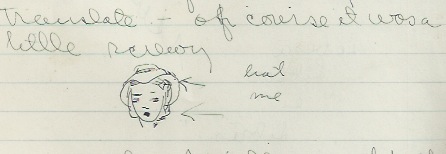
Today was the Midway deadline and as Midway office was crowded, Fraser and Bruce invited me into the French room where Bruce was editing “Potpourri”—so I went to write and bite my pencil and Rosalind Wright came along to chaperone or something. They three talked French while I scribbled or tried to—finally Rosie left and I continued; they started to talk about my hat in French as I gathered from “Joan’s chapeau” or something of the sort. . . . They said it was “de trop” and so forth which unfortunately I could translate—of course it was a little screwy.

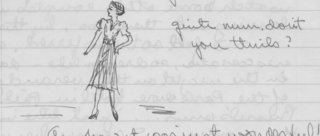
Joan's doodle of her hat, March 1, 1939
Joan’s doodle of her hat, March 1, 1939

Finally we got put out of French room—wandered into art room and studied modern results of p.e. (progressive education), limbs floating around, etc. Oh well—Bruce draped himself up as some Roman in a green tablecloth affair and we all howled heartily till we saw the cleaning man was spying on us. Then Fraser and I began to discuss the Second Oration (our outside reading) which is decidedly not a subject for mixed company.[1]

Midway office was still crowded so I retreated in Correlator office where Kenneth was typing. He has a unique method of bouncing paper off typewriters but I won’t go into that. I swore I’d be quiet as a mouse and started out to do so. Fraser and Bruce came in—talked to me—I tried to be quiet but no can do. Fraser began to recite his Greek something or other and Kenny shouted vainly, “Quiet!” Then Bruce finally retreated and Oliver came in to write his sports page—got along O.K. for a while, then Dick came in and tried to figure out his pet ambition which was the “Inquiring Reporter” question this week. Then we started to talk about the assembly today and he wouldn’t let me answer anyone else, which got Oliver mad and delighted Kenny.

Says Dick: “Listen, I’m speaking to Joan. Please be quiet.”

Oliver: Glare, glare.

Kenny: “Ha-Ha!”

Me: Gulp, gulp.

And so on . . .

Then we started on ambitions again (Kenny had given up by this time) and no one could think of anymore till Kenny said, “To seduce Mae West,” which nice little girls didn’t talk about when I was young, so I gulped and continued to smile brightly and changed the subject (more or less). . . .

Finally Kenny put us out, as he was going home. I turned in my article and Dick lugged in my coat from the deserted Correlator office. He put it on me too and as it was the horrid seventh grade relic (as my other’s at the cleaner’s) all the holes showed gorgeously. . . . Oh well. . . . Someday I’ll be a genius. Bruce wants to be a psychiatrist (I can’t even spell it!) but I wouldn’t let him examine my brain though Fraser said I wouldn’t miss it. (Grrrr.)


[1] Presumably because of its references to unpleasant subjects.

Finally, on a personal note, I am indebted to Helen Cordes, Executive Editor of New Moon Girls.

Helen Cordes

Helen Cordes

I met Helen the week both our husbands began teaching at Southwestern University in 1993.  We were in a bank and, as I recall, she had a baby with her–a baby who is now studying in graduate school with (coincidentally) my nephew.  My husband and I joked that if we wanted anyone to home school our children it would be Helen.  But she was busy with her own kids!

Norah’s American twin

Many thanks to Alison Twells for this lovely tribute to my mom’s book–she is working on her great aunt’s wartime diary — Joan’s English “twin.”

Alison Twells's avatarA girl in wartime

‘Got my hair set today. In my opinion, if I had hollower cheeks, I’d be a perfect double for Garbo.’ This is not Norah Hodgkinson writing, but fourteen year-old Joan Wehlen from Illinois, in her diary entry for 3rd May 1937.Home Front Girl

The daughter of Swedish immigrants, Joan was born in December 1922, and so was two-and-a-half years older than Norah. Like Norah, she was from a socialist family. She became a scholarship girl at a college attached to Chicago University, where she went on to study anthropology as an undergraduate in the 1940s.

One of the delights of discovering Home Front Girl are the similarities in Joan’s and Norah’s interests, preoccupations and the general giddy tone of some of their diary entries. This shouldn’t surprise us, of course, but I enjoyed all the more Joan’s comments about school and family life, films and classical literature, the colour of her lipstick, her crushes on boys (‘BBB in B’: the Beautiful Blue-eyed Boy in Biology).

Even…

View original post 569 more words

The Diary of A(nother) Young Girl

Here’s a lovely review of my mom’s book–from Chicago Book Review!

Kelli Christiansen's avatarChicago Book Review

CBR_Logo2

Home Front Girl:
A Diary of Love, Literature,
and Growing Up in Wartime America

 by Joan Wehlen Morrison


9781613744574 hi res cover imageWartime diaries written by young girls are something of a rarity, so it is more than likely that Joan Wehlen Morrison’s engaging Home Front Girl will be compared to such titles as Anne Frank’s World War II classic Diary of a Young Girl and Zlata Filipovic’s more recent entry Zlata’s Diary: A Child’s Life in Wartime Sarajevo. Such comparisons are apt, so long as they don’t detract from the unique voice captured in Wehlen’s work.

Pulled from journal entries and school notebooks, Home Front Girl reveals the daily goings-on, thoughts, and feelings of young Joan Wehlen. Written between 1937 and 1943, the book captures Wehlen between the ages of fourteen and twenty while a student, first at Greeley, then at Lakeview, and finally at the University of Chicago Junior…

View original post 684 more words

Story Circle Book Review of Home Front Girl

Story Circle has reviewed my book!  I joined Story Circle over a year ago and have really reveled in the support the group gives women writing memoirs and personal stories.  They review books “by, for, and about women.”  booklogo_tn

A lovely review by Trilla Pando has just appeared.  It’s a perfect review!  You can read it here.

Here are some highlights:

This book is more than an interesting and well-written account of an individual; it is history….Kudos to that daughter, Susan Signe Morrison, who took volumes and volumes of diaries, journals, school notebooks, and other documents and crafted both a loving portrait of her mother as a young girl, and an accurate history of time and place.

Memoir and journal lovers will relish this book. But I can also see it on American History reading lists in both high schools and colleges. Were I ever to teach a journaling workshop to young people, this one would top the list.

When I really appreciate a book, I share it. A friend who has a birthday coming up might want to watch her mail box. Don’t worry. It’ll be brand new. Mine is a keeper and has already found a place on my overcrowded bookshelves.”

A Love for England: The White Cliffs of Dover

Joan loved England all her life.  She first visited there with my dad, Bob, in 1951, and continued to travel there until 2004, when my husband, children, and I lived there for a year.

She first came to love England through literature, which is, I suppose, how many of us come to love a culture and a people.

Here she is at age 14, writing about the coronation of Queen Elizabeth II’s father.

Wednesday, May 12, 1937

This day is the 12th of May in the year 1937 and it was Coronation Day. I woke up at five o’clock, turned off the alarm, awoke again at six and listened to the actual coronation. I bundled up in all my blankets, leaving one ear out, and sat on the sofa listening.

Joan's doodle of her listening to the coronation on the radio under blankets
Joan’s doodle of her listening to the coronation on the radio under blankets

I heard George pronounced and anointed King and Elizabeth queen.[1] Wonder what Edward VIII who abdicated is thinking tonight. When they sang “God Save the King,” while I was putting on my stocking, I simply listened like a loyal Englishwoman. I would have even stood up, except for the cold and I couldn’t stand on one foot. I just sort of listened and thought of the peoples of all colors in all lands who were listening and wondered what they thought. (That shows what reading Kipling[2] can do—it’s made me a better Englishman than American.) Well, Coronation or no Coronation—there was school today. . . .


[1] These are the parents of Queen Elizabeth II.

[2] Rudyard Kipling, English poet who often described the colonies of the British Empire. He won the Nobel Prize in Literature and is famous for books such as The Jungle Book.

She writes about the famous White Cliffs of Dover in her poetry.

June 4, 1939                                                                                                  


                     While in Britain

                     The Druid columns crumble

                     And the white cliffs rust

                     Underneath the grass

                     A Roman centurion

                     Is becoming a tree.


                     By Severn’s stream

                     The Norseman’s

                     Ripe rich mold

                     Has long been

                     A bramble hedge.


                     Only where it is quiet

                     The most ancient of all,

                     The Brit,

                     Is a hill.


                     I, too, have a gift

                     See, I give this little girl

                     To the island

                     That it may become

                     An English flower.

This last stanza references Joan’s belief she gained from science class.  There she came to believe in the conservation of matter, where “all matter goes on forever. When I die, perhaps I shall lie in the cool earth, and grass and flowers and weeds will send their roots to find food in me—in my dead body—perhaps then useless to me. But useful to the flower root—the thin, sensitive white root hairs shall enter me and use me. And the flowers will grow. And a deer will eat the flower and a man will shoot the deer and his family eat the deer and I, I shall be in them all. And who shall know me then? Will all my secret atoms ever find their way together again to form the same cohesion that made me? Such is the conservation of matter and shall my soul too find a use? Or ever cling together with my original atoms again?—In the church I looked at the wood—the hard, varnished wood of the pew and I thought, “This was once springy wood through which the sap of life went up in spring.” Oh, is nothing ever lost? It gives you a secret everlasting feeling to know part of you at least will never be lost. . . .” (written age 16, January 15, 1939).

The White Cliff of Dover become a symbol for England itself, standing firm in the wake of the Nazi onslaught.

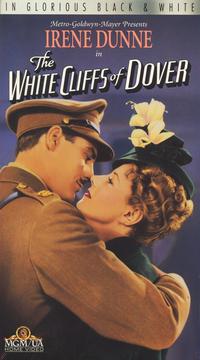
A 1944 film with the title, The White Cliffs of Dover, features Irene Dunne as a young woman visiting England before WWI.

Passionate embrace from The White Cliffs of Dover

Passionate embrace from The White Cliffs of Dover

She loves England – and those White Cliffs.

Poster for the 1944 film The White Cliffs of Dover, starring Irene Dunne and Alan Marshall

Poster for the 1944 film The White Cliffs of Dover, starring Irene Dunne and Alan Marshal

You can see a scene from the movie here.

“The White Cliffs of Dover” also became the iconic song of the WWII era, sung by Dame Vera Lynn.