RSS Feed

Curriculum Guide and Book Club Discussion Questions

Now the Curriculum Guide and the Book Club Discussion Questions sheet for Home Front Girl are available for download.  home-front-girl.jpgPlease use and share them with teachers, students, and other interested parties.  I hope you find them food for thought!

Click Discussion Questions_Guide_website sheet to download it.

Click HFGCurriculumGuide to download it.

I had fun writing both these pedagogical materials.  And I hope they will help readers, students, and teachers as they explore World War II and the events that lead up to that time.

Each Chapter Guide includes:

  • Vocabulary

  • Discussion Starters

  • The guide facilitates the deepening of curriculum standards and objectives.

There are also:

Curriculum Connections

Culminating Activities

And a Q & A with Susan Signe Morrison (me!), Joan’s daughter and the editor of the book.  I hope you enjoy these supplements to Home Front Girl and that they make your class or Book Club discussions more focused and enjoyable!

World War II Documents Found Recently

It seems there is no end to documents being recently discovered about World War II.  There is my mother’s diary, of course, now published as Home Front Girl:  A Diary of Love, Literature, and Growing Up in Wartime America.  I found it after her death in a file cabinet long ignored. And it enables us to see what a real-life American teenager felt and thought in the lead up to World War II.

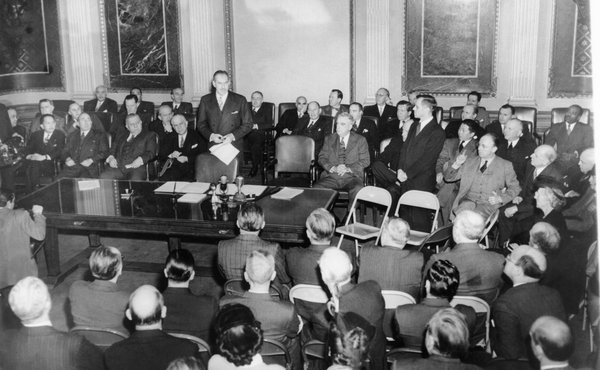
The New York Times recently reported how a transcript was found of the Bretton Woods conference.  At this 1944 conference, 44 Allied nations gathered together in the town of Bretton Woods in  New Hampshire.

Acting Secretary of State Dean Acheson, standing at center, and representatives of 28 Allied nations met in Washington in 1945 to sign the pact reached at the Bretton Woods conference. From The New York Times article by Anni Lowrey, Oct. 26, 2012.

At this conference, the International Monetary Fund and the World Bank were created.  So the impact of this conference is huge down to today.

John Maynard Keynes addressed the Bretton Woods conference, where the International Monetary Fund was created. From The New York Times article by Annie Lowrey, Oct. 26, 2012

You’d think that in this modern age such a transcript would have easily been retained.  But that wasn’t the case.  The writer of the article, Annie Lowrey, quotes a historian from the University of California, Davis, as saying, ““It’s as if someone handed us Madison’s notes on the debate over the Constitution.”  That’s similar to how I felt on finding my mom’s diaries–as though I were handed a key to her teenage years.

Hindenburg Explosion from 1937: New Scientific Theory and Joan’s Reaction

There is news about the Hindenburg disaster from 1937.  A news report tells us a theory just devised which argues for the true cause of the accident:  static electricity.  Read about the theory here and see a video from the catastrophe.

Joan often mentions events of the day in her journals. She writes about hearing about the burning up of the famous zeppelin.

Thursday 5/6/37, Age 14

Hello!  The German zeppelin Von Hindenburg crashed not three hours ago at Lakehurst, New Jersey.  That great new sister ship to the Graf Zeppelin!! Just burnt up like that.  The radio announcer said it was ‘cause the lightening set fire to the explosive hydrogen in the ship and then it exploded.  Airships seem to have a curse or something – to everyone except the Graf Something disaster has happened.  Now the Graf is the only one left.  The Herald Examiner said 100 people were killed, but as it’s a Hearst paper, 50 is a safer guess. They always exaggerate!  Ho-hum—must read about Renaissance art now— um—um.

Good Night!

The announcer’s eyewitness report is heartbreaking and famous.  Listen to the report Joan heard on the radio here.

Yang and Yin — and Serendipity

Life often has strange coincidences!  I’m currently reading writings by my mother, Joan, from Thursday Sept. 29, 1938 when she was 15 years old.  This passage, not in Home Front Girl, begins with Joan taking a walk after fighting with her parents.  She’s soon cured of her anger.  

Passing the houses, it seemed that they were all part of my dream, the people and lights and voices in them—the man pausing to light a pipe under a street lamp — the boy on his bicycle through the friendly night, the woman humming as she passed me with her bundles—all these part of a dream of mine, I thought.  Passing courts where the lights made clean shadows—clear cut shadows on the cement—grass, only a colourless dark mass in the night—trees, the strange shapes of them silhouetted against the dark sky.  All, all was a dream.

When Brahma ceases to dream

Say the people of India, heaven

And Earth shall pass away.[1]

            But this was my own dream—personal—yet not of me—by me, perhaps.  So I walked home through the night and reaching our court, paused, breathless, seeing the stone seat framed like a part of a dream under the unearthly lantern lights.   The light was such that it fell nowhere, yet enabled you to see clearly. I entered the dream of the light and sat on the stone ledge….

            I watched the people go by and somehow they were far outside of me—they did not seem to see me.  The shadows lay like long, grey dreams on the street, crooked and moving with the wind.  The shadows of the leaves were large enough for me to lie upon, so the light magnified them.  I watch my own indistinct shadow upon the wall.  Then my eyes fell on the dark bush beside me.  It, too, was part of the dream. I remembered when I had dreamed it in the spring when the scent of the young grass was still on the air.  The leaves on the bush had been many and moved lightly in the fragrant air.  Now the bush was dark and all but leafless.  It moved a little in the hazy-half-light.  It looked real—perhaps it had a dream of its own.  It came over me that only the things that were real were in my dream, and that the minute I acknowledge them as real, they became a dream, unreal.  And yet all things were seeming to fit into my dream. 

            A car pierced the night.  Some people passed, a dog barked.  I got up to go in—Looking back, I could see the hazy circle of light wherein I had sat.  It looked complete without me.  I went into the house convinced that all was a dream.  (Incidentally, I’ve been reading Yang and Yinil_75x75.369214797_py8jnot that this could influence my train of thought.)  I went to bed and lay looking at the black night….

I’d never heard of a book named Yang and Yin so I googled it.  And it popped up on an Etsy website:  Jen’s Closet with cool vintage stuff.  You can check Jen’s site here.

Jen has [well, had; I bought it!] a first edition of Yang and Yin, a book by Alice Tisdale Hobart, about an American doctor in China.  It turns out Alice Tisdale Hobart went to China as early as 1908 and later as well as the wife of an oil executive.  And she went to (but never graduated from) the University of Chicago, where my mother studied!

il_570xN.369214423_g5ub

I let Jen know why I was buying the book and she’s written beautifully about our conversation.  Please read her blogspot here.  She writes, “Yes, one of the reasons I have my Etsy shops is to make money, of course, but it goes deeper than that.  At least once a week I hear a story from one of my customers about why they have purchased a certain item.  Often I hear from my customers that the item brings back special memories from their childhood.  I love that!”FotoFlexer_Photo2

Is it serendipity?  Coincidence?  Who knows…..


[1] Paraphrase from Kipling’s The Bridge-Builders.

How can Joan be so literate–and literary?

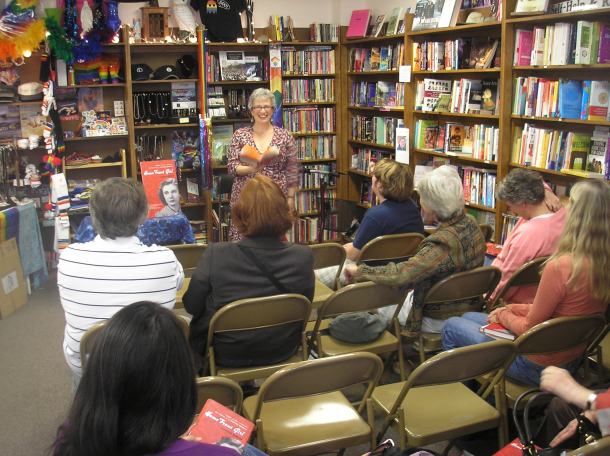
At a book reading at BookWoman in Austin, Texas, dear friends and colleagues came and listened to my reading of sections of Home Front Girl:  A Diary of Love, Literature, and Growing Up in Wartime America.  They had wonderful questions and suggestions–even that I should make an audio recording of it, which I would love to do!

Reading Home Front Girl to kindred spirits at BookWoman

One person commented on how literate Joan was.  Some might ask how it could be true–that such a young girl was so literate.  But Joan came from a literate family.  Her parents, though working class, loved to read and discuss literature–fiction and poetry.  They even met at a night school called The Lewis Institute, now part of Illinois Institute of Technology.  Joan grew up reading Kipling, Tennyson, Sir Walter Scott, Shakespeare, Edna St. Vincent Millay, O. Henry, and Christopher Morley, the novelist.  Their writings aren’t particularly “easy”–but if you don’t have easier things to read, you just read what you have and assume it’s expected of you to master such writings.

Joan falls in love with A.E. Housman at the age of 14.  As she writes, Wednesday June 16, 1937

If anybody had told me a year ago that I’d be taking poetry from the library and reading it not only willingly but joyously (!), I would have thought whoever it was crazy!  However, it’s true.  I got out “A Shropshire Lad” [by A.E. Housman] and am really liking it.  I never thought it in me.  I also got out Pope’s translation of the Iliad, but it looks forbidding so I haven’t started yet.  However, I’m still human as I also have (on my new “adult” card, of course) “The Garden Murder Case”[i] and a Christopher Morley book[ii].  So fear not for my mind.  But I do like poetry.  It’s quite surprising really.  I haven’t quite recovered from it yet.

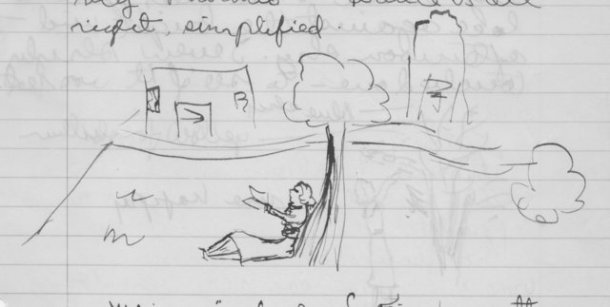
Here is Joan reciting A.E. Housman to herself in the park.

Joan reciting poetry to herself under the forsythia


[i] By S. S. Van Dine; published in 1935.

[ii] Most famous for his 1939 book, Kitty Foyle.

“Isn’t life strange?” Meteors, Calamities, and Memories

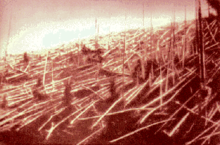
The meteor striking the atmosphere over Siberia on February 15, 2013, was, of course, not the first such disaster to strike the region. In 1908, an asteroid struck Tunguska, Siberia, ramming into the earth with power 1,000 times that of the atomic bomb that destroyed Hiroshima.  My grandfather, Werner Wehlen, saw that explosion when he was twelve years old on his parents’ farm near Sundsvall, Sweden.  Only when he was 83 years old, after he had immigrated to the United States and settled in the Midwest, did he learn what it was he had witnessed that summer day 70 years before.

Trees knocked over in the blast from the 1927 expedition.

Trees knocked over in the blast from the 1927 expedition.

As he told his story in his lilting accent, “Last week I went to a lecture given at the University of Chicago given by a famous astronomer from Harvard.  He told about a new theory they have now; that a tiny particle of antimatter–something very dense but very small–passed right through the earth in 1908. It left a big circle of wreckage in Siberia and it came out somewhere in the South Atlantic.  There was a flash of light seen over northern Europe at the time that it was supposed to have hit.  As he was talking, I remembered seeing such a flash, sitting in my farmyard in Sweden when I was a boy.  It was so bright it took the color out of everything, even though it was daytime when I saw it.

“After the lecture, I raised my hand and told the astronomer I had seen that light.  He became very excited and asked me where I was when I saw it and what year it was.  I was able to date it pretty exactly, because it happened at about the time of the death of a cousin of mine.  The astronomer wrote down my name and the place I lived in Sweden.  Then he told me I was lucky, because I was probably the only person in the room to have seen that flash.  In fact, I was the only person he had ever met who had seen it.  Most of the other people in the lecture room were young students, and the astronomer himself was only about forty years old.

“Just think. I had seen that flash from my farmyard in Sweden when I was a boy, and I had to wait till I was eighty-three to learn what it was.  Isn’t life strange?”

My grandfather, Werner Wehlen, in 1984 at age 87 after his first airplane ride.

My grandfather, Werner Wehlen, in 1984 at age 87 after his first airplane ride.

For my grandfather’s generation, waiting a lifetime to find out about a scientific or environmental calamity, would not be unusual.  Now, videos of catastrophes are uploaded on YouTube filmed by dashboard cameras and shared with the world almost instantaneously.  Isn’t life strange?

Sometimes stories don’t have an ending for decades, as my grandfather sensed with this event, tying his youth to his old age.  His story was recorded for American Mosaic, a book co-written by my mother Joan Wehlen Morrison.  My mother felt that everyone has a story, one that may not yet be apparent. As she writes at age 18 on October 19, 1941, “to understand one’s story is to weep with pity.”

Joan also writes about the coincidence of personal, political, and environmental calamity.  On Thursday, January 26, 1939, at age 16, she writes about the death of her best friend’s father.

“Gee, I came home and Mom told me. I used to play cards with him and tell jokes and I saw him last Saturday and today he is dead and the Spanish Civil War is over and the Chinese War is going on and 8,000 people died in the Chile Earthquake and people all over the world are eating their suppers and doing their homework (as I shall) and laughing and reading and moving about in lighted rooms and a man I know is dead.

"El Mirador Alemán", in Concepción, after the earthquake.
“El Mirador Alemán”, in Concepción, after the earthquake.

It’s funny . . . coming home on the elevated train tonight I made an equation—a geometric equation to prove that Life cannot be cancelled.

Matter + Energy + X = Life

Matter and Energy cannot be cancelled.

Therefore: you cannot cancel Life.

But I don’t know. I will not be speaking to my friend’s father any more.

I feel low to be eating and writing in here and doing my homework when someone is dead . . . but someone is always dead. . . . 8,000 people that other people knew are dead in Chile. Barcelona fell to the Rebels and a war is over and I talk thus.”

The actual death toll in Chile was much higher, estimated to be between 25,000 and 50,000.

50th anniversary  of 1939 Chilean Earthquake Commemoration placard

50th anniversary of 1939 Chilean Earthquake Commemoration placard

My grandfather, on learning what he had seen in the “old country,” asked, “Isn’t life strange?”  Now we know that an object half the size of a football field narrowly missed the earth on the same day that another object –thankfully, much smaller – slammed debris into it.  Life is strange—and precious.  All we have—the dashboard cameras, the YouTube videos, the farmyards, the diaries, the memories—could disappear in a flash.

A flash that may be remembered by someone decades hence.

World War II & NYC: New York Historical Society Exhibit

How wonderful that an exhibit has opened at the New York Historical Society on World War II & NYC.  This exhibit will be open until May 27, 2013.  The exhibit has four sections:

1. New York Before Pearl Harbor, 1933–41

2. The New York Home Front, 1942–45

3. Going to War, 1942–45

4. Victory and Loss, 1945

Be sure to explore the site if you cannot attend.  Or explore before you go to the exhibit so you can xero in on exhibits that more interest you.

This site has many wonderful photos.

Here’s a poignant Soldier Portrait by Ben Brown

General and future president Eisenhower

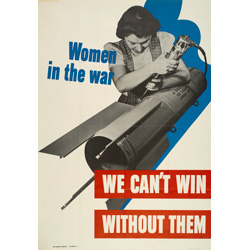
And what about this amazing poster!

Poster about Women in the War

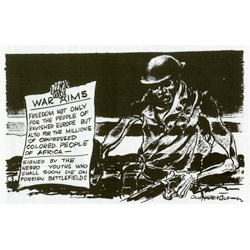
And this chilling cartoon:

This cartoon about War Aims by Oliver Harrington pulls no punches!

Do let Home Front Girl Diary know if you have attended and what your impressions were!

This New York Times article by Edward Rothstein reviewing the exhibit has more photos, so be sure to check it out!

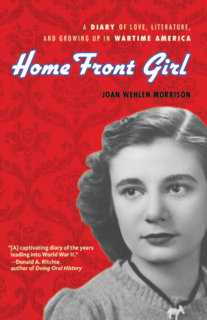
This is a lovely new review: I highly recommend Home Front Girl as a primary source for research and insight into the Greatest Generation as so many have called Joan and her peers.

hollypapa's avatarBookscoops

Home Front Girl


I feel like I have a new friend after reading Home Front Girl. Joan Wehlen was so palpable on the pages of this book, that I wish I had in fact met her and could call her my friend. Full of historical snippets and teenage soliloquys, Home Front Girl is the Yin to Anne Frank’s Yang.

One of my favorite parts is something Joan Wrote at age 17:

“Oh you, my generation! –we were a lovely lot! Sharp minds—arguing all the time and brittle bodies and even more brittle laughter—and all the time knowing that we were growing up to die. Because we weren’t fooled, you know. All through those bright-colored years of adolescence we knew we were growing up to disaster. For at least four years—well, three, before it happened, we knew it was coming. Some sort of inner sense of war lay upon us. We were pretty…
View original post 238 more words

The Andrews Sisters and Popular World War II Music

The last of the Andrews Sister, Patty, died this week.  31andrews-trio-articleLargeHow iconic they and their music was and will continue to be!  Songs like “Bei Mir Bist Du Schoen (Means That You’re Grand)” and, of course, “Boogie Woogie Bugle Boy” are part of the panoply of the world’s music.  They also sang with Bing Crosby and his light baritone was jazzily accompanied by their energetic rhythms.  You can read the obituary of Patty here.

ANDREWS-obit-articleInline

I like to think that their work in World War II, boosting morale, selling war bonds, entertaining troops overseas, also extends to their wearing uniforms.  I’m sure many a girl was inspired to join the forces:  “If the Andrews Sisters look so attractive in their smart uniforms, maybe I can.”

My mother writes about the one of the songs they were known for, a funny novelty song named “Mister Five By Five,” about a man who is five feet tall and five feet wide!  You can hear it here.

One of the poems of my mother, Joan Wehlen Morrison, was written about a year after the United States entered the war, in February 1943.  Joan references popular music, including some by the Andrews Sisters.  Read, listen, and enjoy!

….The songs that are trite to us now

May make us weep sometime because they bring back

Days that were when everything was yet to be done

And the world lay far below us—

Still to be ventured.

I don’t want to walk without you, baby” . . .

I left my heart at a stage-door canteen” . . .

This is worth fighting for. . . .”

We may even cry because we remember

That “Mr. Five by Five” made us smile once

And the “Strip Polka” will seem quaint and old-fashioned….

Diaries and World War II

Diaries allow us to witness history before it is past.  We see what people think while it is taking place.  History books have their place, of course–we can see how an event that seems — in retrospect — to be inevitable given the circumstances came to happen.
But while people are experiencing what later gets to be called “history,” they often don’t know what the result of actions and events will be.  My mom, for instance, in writing about the war at Christmastime in 1940 at age 18 writes, “And all the sudden, in an emotional intensity, I thought, “This may be the last Christmas we shall have” . . . I should be wise and know the world will never end. . . .”  But she didn’t know that at the time.  It seemed, given all the grim war news after the fall of France and so many other countries in the spring of 1940, as though the world was to be utterly conquered by Hitler.  She couldn’t have yet known that the Nazi invasion of the Soviet Union would prove to be a fatal strategical move (thank goodness!).

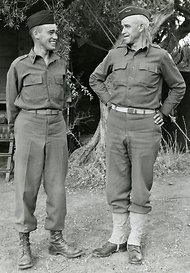
A recent obituary tells of another WWII diarist:  Chester Hansen.  He was an aide to General Omar N. Bradley who commanded ground forces on D-Day.  But Hansen had been with Bradley since the time he trained in Louisiana, to the North Africa campaign, and then the invasion of Sicily.  Hansen’s diary came to number 300,000 words!

Chester Hansen, left, in Sicily in 1943 with Gen. Omar N. Bradley. From the New York Times obituary by Leslie Kaufman, Oct. 29, 2012.

As the Times article quotes from the entry concerning D-Day, June 6, 1944:  “Like others in the Army party, Bradley was up at 3:30. He is on the bridge, a familiar figure in his ODs with Moberly infantry boots and OD shirt, combat jacket, steel helmet. He smiles lightly as though it is good to be nearer the coast of France and get the invasion under way.”

The archive of Hansen’s works is at US Army Heritage and Education Center.  For lots of neat videos about Bradley, check this page out.  Curators using the original documents in the Bradley archive have to wear protective gloves.  I know have my mom’s diaries in protective plastic sheets since the paper is so crumbly.  Original documents need to be protected so future readers can use them.