RSS Feed

Armistice Day 1941: A Tribute to Veterans Day

Veterans Day didn’t even exist until 1947.  Before that it was called Armistice Day, in memory of the armistice signed between Germany and the Allies in World War I, bringing an end to fighting on the Western Front.  Famously this took place on the 11th hour of the 11th day of the 11th month in 1918.

New York Times front page on November 11, 1918 that the Armistice is signed.

Joan is much affected by World War I.  In fact, she sees her generation–those born after World War I in the Roaring 20s— as being ” a generation apart.”  The entry below was written when Joan was 18, just 3 weeks before the bombing of Pearl Harbor and the entry of the United States into World War II.

Thursday, November 13, 1941

Day before yesterday was Armistice Day, if you can call it that—1941 A.D. . . . If we live, we’ll look back on these days and know, perhaps, either that they were not as important as we thought they were—or that they were much more important. God, in the heavens, look down on the world! . . . Today they finally finished repealing the Neutrality Bill.[1] Arm our ships and send them into belligerent ports—drums beating louder now—we had a peace meeting at school day before yesterday—what the hell, what is Armistice? Time goes on.

The Treaty of Versailles finally brought an end to hostilities between Germany and the Allies in World War I and was signed in 1919. If you are interested, you can read the text of it through this site here.

Treaty of Versailles, 1919

Let us in 2012 remember and pay tribute to all the veterans of all the wars!

[1] One of the bills of the 1930s that came from noninterventionist desires. With its repeal, the involvement of the United States in World War II was only a matter of days.

Guest Blog Post at A Bookish Affair: Our Fascination with World War II

Please read my guest blog post at A Bookish Affair about our fascination with World War II.

And read the latest review of Home Front Girl  at A Bookish Affair:  “[C]ompulsively readable.”

A Bookish Affair blog website banner.

My dear daughter

I just want to be able to thank Sarah, website master extraordinaire.  I had put this website together basically alone–with some help from WordPress Support Pages.  I remember the thrill of conquering drop-down menus!  Woo-hoo.  It only took me 7 hours…..

But the header for my page was causing me problems.  How could I add a photo of the cover?  How could I have the fonts match the book jacket?  Such are the dreary woes of the website owner.

Then, along came my 16 year old genius, a.k.a. my daughter, Sarah.

Sarah, Photoshop whiz extraordinaire. Kudos and thanks!

She knows how to do Photoshop.  She knows how to get fonts that match.  She knows….well…just about everything!  In one hour (or less) she had managed to replicate the book cover’s fonts, change the color palette of the site to match the book, and do everything I asked for.

She made my dreams come true!

Hollywood Preparing Women for WWII

Hollywood helped Americans prepare psychologically for WWII even before the U.S. was bombed by Pearl Harbor.  By that time, Europe had already been convulsed in war for over two years.  The film, “Come Live With Me,” starring the gorgeous Hedy Lamarr and Jimmy Stewart, is a charming comedy recently aired on TCM.  Released early in 1941, it has some somber moments that would have particular resonance with women at the time.

Hedy Lamarr

Lamarr plays a Viennese refugee whose father was “liquidated” in what used to be Austria.  She has fled Europe for the U.S. and is dating a married publisher who enjoys a “modern marriage” with his wife.  Lamarr is threatened with deportation due to her lapsed passport.  But the immigration officer gives her a week to find an American citizen to marry so she can stay (would that happen today?).

Stewart is a writer who has no money.  So Lamarr suggests he marry her:  she’ll give him a weekly allowance so he can write and she’ll have the security of a marriage license.  They do not live together and she visits him once a week to pay him off.

But Stewart is starting to fall in love with her and writes a book based on this strange situation.  He sends it off to none other than the publisher Lamarr is involved with (of course!), saying he doesn’t know how the story will end.  But we can hope!

Jimmy Stewart

In order to have her fall in love with him, Stewart practically kidnaps Lamarr (who is also starting to be interested in him), taking  her to the countryside where he grew up on a farm with Grandma, played by Adeline de Walt Reynolds, who dispenses wisdom as featured on her home-embroidered samples.

When Lamarr sees the proverb “Time Heals All Wounds,” she — thinking of her dead father — expresses doubt that that is true.  But Grandma says that if a woman can birth a dead child, and lose a young husband to a falling tree, and go hungry for a year due to flooded fields, she can rise above anything.

Adeline de Walt Reynolds who plays “Grandma”

Then Grandma says, “There isn’t a woman in the world who hasn’t had reason to doubt sometimes….Part of living is meeting tragedy and rising above it.  A woman doesn’t amount to anything unless she can do it.  It takes a long time to learn that that is true.”

Grandma’s wisdom heals Lamarr, but it also is meant as a lesson to women on what would soon become the home front in the United States who would be facing their own tragedies soon enough.

This charming ad features a caricature of Jimmy Stewart and Hedy Lamarr in the 1941 comedy “Come Live With Me.”  At the end of the film there is an even cuter one with them as lightning bugs (hard to explain if you haven’t seen it!).

Author’s Books

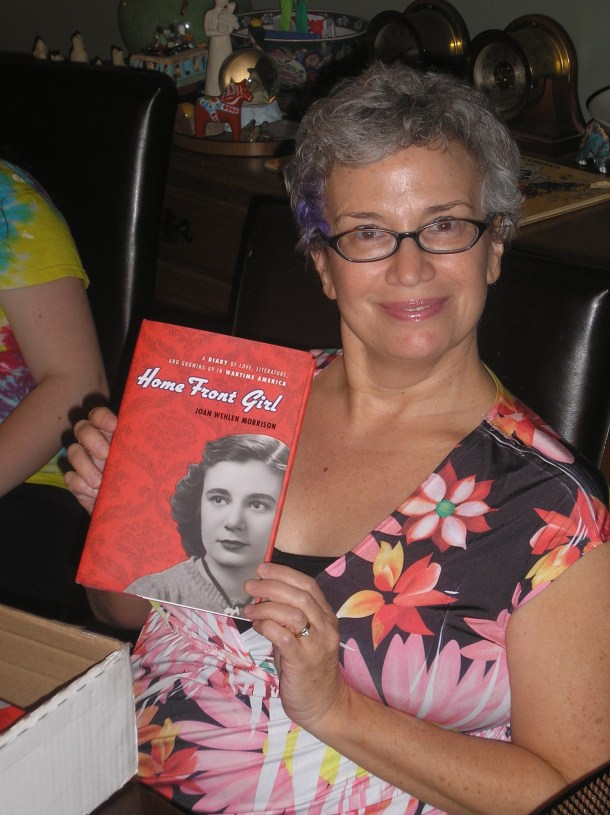
One of the most exciting moments in a writer’s life is when the book you’ve been devoting your life to — not only physically, but emotionally and, in this case, even spiritually — arrives in the mail as an actual physical object.

The other night, my family gathered ’round: Jim (my husband), Sarah (age 16), and John (age 11).  Jim placed the box before me that had arrived in the mail from Chicago Review Press.  We all stared at it like it was some strange and ancient talisman.

I recall my parents’ reminiscence of their first grandchild.  My niece, Lizzie, was 6 months old and proudly displayed to the family.  My brother, Jim, and his wife, Ruth, placed Lizzie on a blanket before the fireplace on a bleak, midwinter day in New Jersey.  We all sat on sofas and recliners and just….gazed at the baby.  In wonderment.  Here was this lovely creature, otherworldly almost, now gracing our lives.

Well, it seemed like that to us other other night.  This strange and magnificent gift, a bounty from my mother after her death–the diaries squirreled away in the file cabinet not opened in decades–permitting us to get to know her in her teenage years.

Jim handed me the scissors and I tear at the tape holding the box together.  I lift the lid —

And the lovely face of my mom gazes out at me.  The red background pops.  The raised fonts tactically beckon.

And we all, in a hush, are grateful.

Home Front Girl Diary

Susie and Sarah with Home Front Girl, just arrived from the publishers.

Susie holding the physical copy of Home Front Girl by her mother Joan Wehlen Morrison and edited by Susie–here at last!

Doughgirls

You know who the “doughboys” were, don’t you?  It was the nickname of young men who went to fight in Europe in World War I.

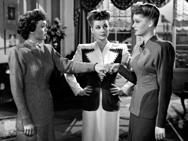
Well, in 1944 Hollywood produced a crazy film based on a stage play called “The Doughgirls.”  My son, John, and I saw it the other evening on TCM.  It might not have been the most “politically correct” film ever, but it was very funny.  All about overcrowding in Washington, D.C. during the WWII.  A lot of films were based on the premise that housing was hard to find.

Here are the three hapless stars: Jane Wyman, Ann Sheridan, and Alexis Smith.

Here are Jane Wyman — at that time the wife of Ronald Reagan — Ann Sheridan — also known as the “Oomph Girl” — and Alexis Smith.

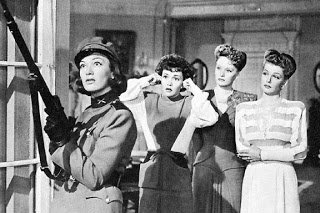
Especially wonderful is Eve Arden, who plays a Soviet officer.

Here is Eve Arden shooting off her rifle in honor of her little sister, just born in the Soviet Union. Don’t ask–it’s too crazy to explain in this screwball comedy!

You can see the trailer for the film here.

Home Front Girl: A Diary of Love, Literature, and Growing Up in Wartime America

Home Front Girl003JoanVirginMaryDecember19380023joan'sengagementphoto011joanautumn010boringvirgil009BritiangoestoWar
006campphilosophical005bpatchcloseup005a6-24-39eyepatch copy002hitlerchamberlain001Joanage4withmotherCover of the book, Home Front Girl

Untiltled’s photostream on Flickr.

Hi!  I’m so excited to be writing my first post for this website.  I hope you like it! It is a blog that goes along with the website for the book Home Front Girl: A Diary of Love, Literature, and Growing Up in Wartime America (Chicago Review Press:  2012).

My mother, Joan Wehlen Morrison, wrote it from ages 14-20 from 1937-43.  Here’s a picture of my mom, Joan, at age 16:

I found her diaries after her death, read them, transcribed them and edited them.  Then I sent out query letters to publishers.

Chicago Review Press is publishing the book November 1, 2012 as a Young Adult History Book.  It’s for ages 12 and up–including anyone 12 to 112.  After all, you probably know someone who lived through World War II who would find it of interest!

The website for the book has lots of material–for fun and learning.  So explore.

And please send comments.  There’ll be updates and interactive aspects to this Blog site!  Welcome!