A Story for Generations: Home Front Girl
Here’s the interview WordPress, my blog hosting site, conducted with me!

 Imagine this: you have access to the diaries of your mother or father: Windows into your family’s past. Snapshots of moments of history.
What would this process be like? To sift through documents, to piece together a life — and, ultimately, your own family history? Susan Morrison, the blogger and author at Home Front Girl Diary, has this very story to tell.
The book Home Front Girl brings her mother’s diaries — penned as a teenager from 1937 to 1943 — to life. Her website and blog, created to complement her mother’s book, weaves personal, family, and world history and allows Susan to interact with her mother (now passed away) in an intimate, creative way.
We chatted with Susan about her project, how she uses her WordPress.com site to promote her book, and her blogging and research advice to writers, historians, and memoirists.
Tell us about the interesting story…
View original post 1,398 more words
Amputees–Boston and in Wartime
I’ve been thinking of both those killed at the Boston Marathon as well as those maimed in the bombing. To be an amputee is heartbreaking, especially given that people were injured at an event which extols physical achievement.
In 1941, Joan encounters a young man who is an amputee.
Saturday, May 31, 1941
. . . Went to Billings Hospital this morning [to volunteer] and, as they had measles, they sent me downstairs to read Captain Horatio Hornblower to a boy. Turned out to be Joe Harmon whom Emily was telling me about Wednesday, . . . 19-year-old freshman from Purdue University. Leg amputated just last week. Hurt it playing basketball. Nice-looking boy with good lean features, bright blue eyes and dark hair. I didn’t read at all, we just talked—about college and everything. . . .
And all the sudden leaning there on the bed—he was telling me how he felt at first and I thought my god, he’s got one leg cut off—oh poor boy—how terrible! — but I couldn’t let him see I was thinking it. . . .
Somehow then the scene from All Quiet on the Western Front came back to my mind—where the two soldiers visit their friend whose legs have just been cut off and they realize how helpless they are—and I had that same feeling.
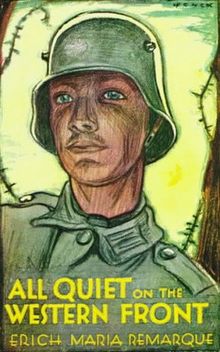
The cover of first English language edition; design is based upon a German war bonds poster by Fritz Erler.
So I smiled foolishly and we went on talking about college and baseball. . . . And I think perhaps he was fooling me, too, talking about such trivial things—when there was a consciousness of something else there . . . A nice-looking boy I might play bridge with in the Coffee Shop or meet on a double date. People, all round the world.
But he said, “I’m not going to let this thing get me down.” I felt so moved in front of so much reality. After a while Emily came for me and we laughed that we hadn’t been reading at all. Well, Joe Harmon, good luck to you. . . .
Time goes on . . . as I rode home I thought of that phrase of Francis Bacon’s in his utopia[1]—used of the Governor, “He had a look as if he pitied men,” and I think that it the most beautiful trait of all—“a look as if he pitied men.”
[1] Francis Bacon, who died in 1626, wrote of a utopia in New Atlantis.
Here is the heart-breaking scene from the film of All Quiet on the Western Front (1930),
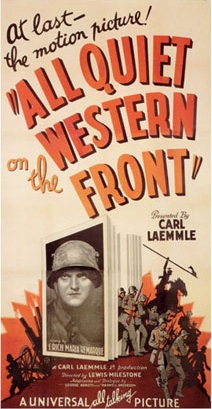
Poster for the movie All Quiet on the Western Front (1930), featuring star Lew Ayres
starring Lew Ayres where the friends visit Franz whose just had his leg cut off.
If you would like to contribute to The One Fund for the Boston Marathon victims, please look at this page.
The Heroism of First Responders and Ordinary People: Army Nurses in World War II: “So Proudly We Hail” (1943)
The terrible events of this week– the bombing at the Boston Marathon, the explosion in West, Texas, the killing of the MIT police officer — remind us how vulnerable we are. And how the simple bravery of ordinary people, from first-responders to passers-by on the street, reveal the honest compassion of humanity. Such generosity of spirit was also seen in the World War II period.
The other night Turner Classic Movies hosted a number of films starring the beauteous Claudette Colbert. So Proudly We Hail (1943) riveted my son and me. It stars the lovely Claudette Colbert, along with Oscar-nominated Paulette Goddard,
 and, in an unusual role, Veronica Lake.


Based on a memoir that had appeared early in 1943 written by a nurse, Juanita Redmond Hipps,

Lt. Rosemary Hogan gets new bars from Maj. Juanita Redmond.
who had been in the Philippines as it fell to the Japanese, So Proudly We Hail follows the lives of a group of nurses, sent out for the U.S. to the Pacific before Pearl Harbor.
Here is a military trailer of the film.
The nurses cannot land in Hawaii after December 7th, and carry on to the Philippines. There they set up camp on the peninsula of Bataan.

Tragedy ensues as Bataan is taken over by the Japanese. They flee in rickety boats to the island of Corregidor where they live in a huge tunnel complex with thousands of soldiers. But this underground space of safety is likewise doomed. Ultimately, the group of nurses the audience has come to know are evacuated to safety. So Proudly We Hail came out in late June, 1943, not long after the evacuation from Corregidor. You can read more about the real “Angels of Bataan” here.
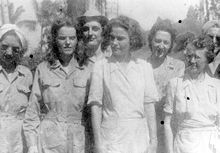
Army Nurses in Santo Tomas, 1943. Left to right: Bertha Dworsky; Sallie Durrett; Earlene Black; Jean Kennedy; Louise Anchieks; Millei Dalton.
A recent highly acclaimed book, The Rape of Nanking, exposes the massacres and mass rapes committed by invading Japanese forces in Nanking, China in 1937-8. These facts were well known at the time.
One of the more unusual aspects of the movie So Proudly We Hail is an exchange among the nurses as the Japanese are due heading to take over their hospital on Bataan. One nurse says she was at Nanking when it was invaded and saw what the Japanese did to the women there. They fought like animals over women and then said it was the privilege of the imperial army. None-too-subtly, So Proudly We Hail takes on the issue of the fear of rape of American nurses by Japanese troops.
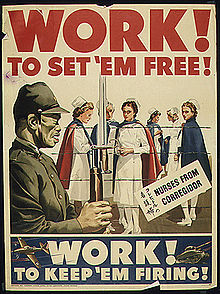
US Government Poster
In Joan’s diary, she writes about the invasion of Nanking.
Wednesday, December 15, 1937
. . . The other day Japan bombed three American ships[1]—one a gunboat—that were in some Chinese harbor and everyone thought there was going to be a war—there wasn’t though, so it’s all right—I hope.
Monday, December 20, 1937
I am fifteen years old. . . .
P.S. Italy and Germany and Japan have a triple alliance now—whatever that means. And the Japanese had a peace assembly at Tokyo this week and are still killing people in China—nice world, isn’t it?
Sunday, January 9, 1938
. . . Last night we went to show and saw Norman Alley’s Bombing of the [USS] Panay. Pictures before and after and all. I wonder how he knew when he made them that those pictures would be so important. An historical document—the paper says.
You can see the actual newsreel Joan saw here.
Sunday, February 20, 1938
I had a horrible dream about war again last night. In my dream I could see the countries of China and Japan spread out before me on a map.[2] I could see people milling about in both countries and in the eyes of the Chinese, in all the eyes, there was a hurried bewilderment and there was a horror in my heart. Someone explained to me what was happening. “The Japanese are too many to fit into their own country so they are sending many of their people over to China.” And I could see it happening—the crowds of people hurrying over the narrow strip of water to China and the ever-thickening bewildered crowds in China, hurrying nowhere. “But,” I asked, “What will happen to all the Chinese—there are too many!” The answer came—slowly and surely, “They will be killed—deliberately and quickly—every one.” And I shouted at my dream, “But they can’t do it—they’re human beings—the Chinese!” And the words were repeated, “They will kill them—everyone.” And an awful horror filled my mind and I saw the people—all of them, hurrying faster—and faster—to nowhere. And faster!
[1] Joan wrote this entry shortly after the horrific Nanking massacre and mass rapes inflicted on the Chinese by the invading Japanese army.
[2] In the margin, Joan wrote “Panay bombing.” The Panay was the US gunboat bombed on December 12, 1937.
In So Proudly We Hail, one character makes the ultimate sacrifice to save the others. To understand it, let me tell you more about Veronica Lake‘s character. Lt. Olivia D’Arcy is played in an atypical role by Lake. Lt. Janet ‘Davy’ Davidson is played by Claudette Colbert. 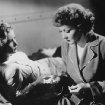 Olivia has been rude and obnoxious; none of the other nurses like her. Finally, a confrontation occurs between her and her senior officer, Davy. The scene can be viewed here.
It is clear that Olivia is suffering from what we would call PTSD [posttraumatic stress disorder]. Courtesy of IMBD, you can read this shocking dialogue.
Later in the film, when the Japanese are shooting in the hospital grounds, Lake takes a grenade from a dead American soldier. She tells the others to flee.
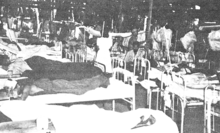
Nurse in Bataan Hospital Ward
Better that one dies so the others will live. Lake hides the grenade in her overalls and heads out to the Japanese with her hands up. We think she will pull the pin and throw it at the Japanese. Instead, she gets close to the enemy and when they are close to her, she pulls the pin killing them — and herself. You can view a section of the film with this incident here.
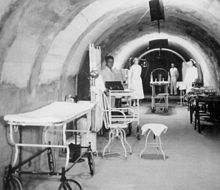
Malinta Tunnel hospital ward (Armed Forces Institute of Pathology)
The entire set up for the movie circles around PTSD. The movie begins after the nurses have been evacuated and they are on their way home. Davy, the lovely Claudette Colbert, is swathed in blankets and practically comatose. The ship doctor says she’ll die because she wants to die. Only if he hears her story can he help. So the film didactically walks us through all the nurses have experienced. Davy’s real crisis concerns her beloved, play by George Reeves, who later became famous as the Superman of the 1950s television series.
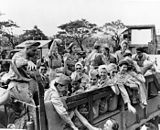
Liberated Nurses, February 12, 1945
American films made soon after the U.S. entered the war can be extremely grim in their tone. At that time, people didn’t really know who would win. The ending of this film succeeds in encouraging the audience to keep supporting the war to help save nurses like these. But the glossy light trickling through the clouds over which the words The End appear does little to rouse hope in the viewer’s heart. Like the first-responders and normal bystanders today, they were willing to sacrifice themselves for others, either through dying or impairment or loss of peace of mind.
“After Harry Potter: A Reading and Workshop on Publishing Children’s and YA [Young Adult] Literature,” Swarthmore College
In my guise at Swarthmore College Alumni Council President (2011-2013), I had the great pleasure of meeting Donna Jo Napoli, Professor of Linguistics, at a reception in fall 2012. We chatted merrily and Donna Jo mentioned she wrote children’s books. Later, when I googled her, I discovered she had written over 70 books!!! And had won many awards! You can read about Donna Jo here.
At the same time, I had know that one of the Alumni Council members, Josh Green, Class of ’92, had written a Young Adult chapter book, The Idea Man. That he did when he wasn’t working as an emergency room doctor or Hawaii State Senator!!!
So the idea came to me that it would be wonderful to create at panel entitled ““After Harry Potter: A Reading and Workshop on Publishing Children’s and YA [Young Adult] Literature.”
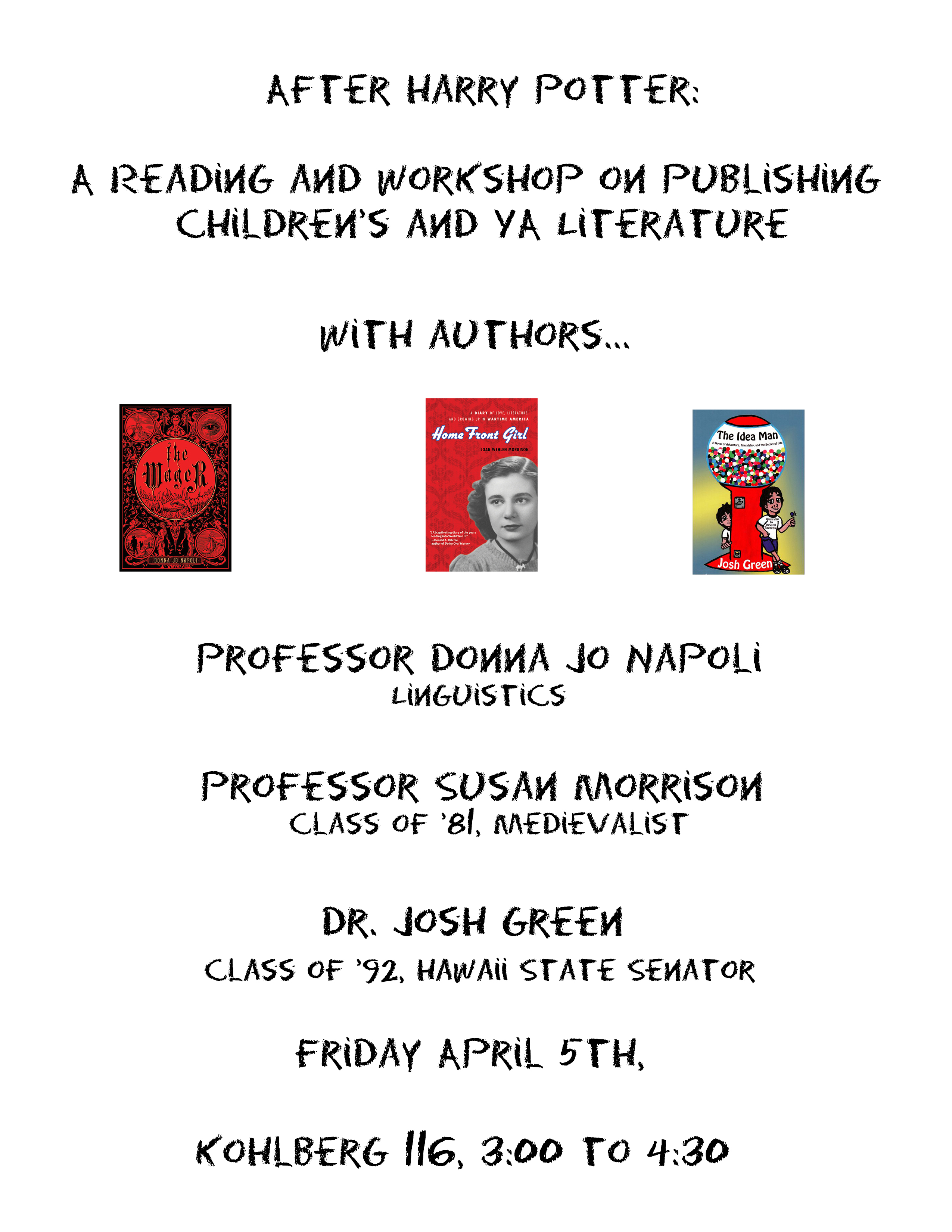
The poster for the event designed by my brilliant daughter, Sarah Kilfoyle. Thanks, Sarah!
It consisted of readings, Q & A, student input, and signings.

Book Display at Swarthmore Event with Josh Green’s The Idea Man, Susan Morrison’s Home Front Girl, and Donna Jo Napoli’s The Wager, Greek Mythology, Mama Miti, and The Crossing.
Josh read from The Idea Man, I read from Home Front Girl, and Donna Jo read from The Wager.
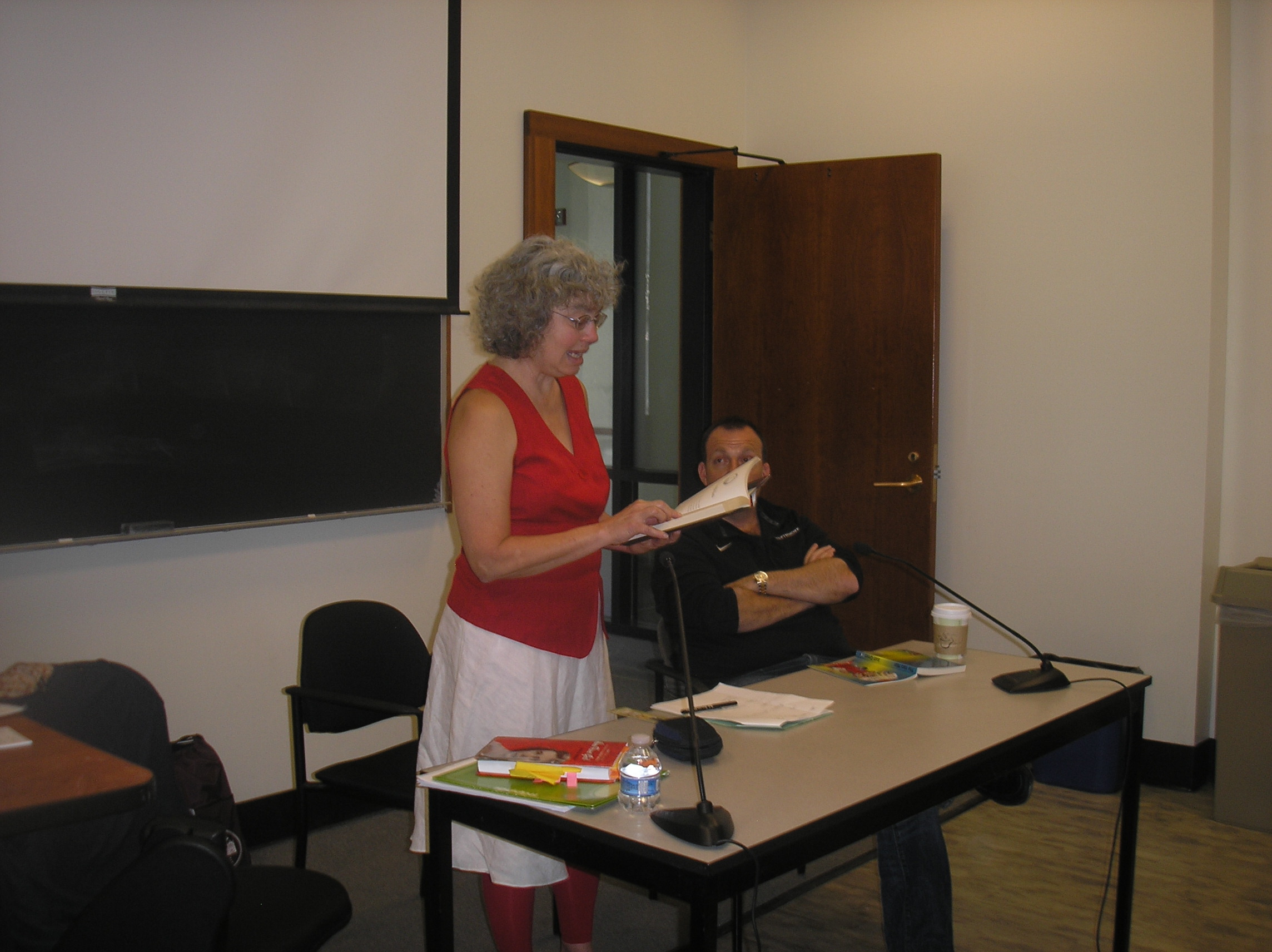
Award-Winning Donna Jo Napoli reading from her exciting book, The Wager (Susan taking photo)
Over 20 students participated, along with a number of older folks. They clearly had great interest in Children’s and YA literature. In fact, about half of them said that they were working on their own children’s and YA literature. Two young women told about how they were collaborating on a children’s book; one doing the writing, the other the illustrations.

Josh Green reading from his fun chapter book, The Idea Man (Susan taking photo)
After I told about how I had written a Harlequin Romance named Stairway to Love (unpublished–so far!) when I was a freshman at Swarthmore, Donna Jo encouraged that students to write anything, any genre: from erotica to SciFi to Children’s books. I hope the students form a writing group focused on Children’s and YA literature! We’d love to support you!

Donna Jo and Josh at the reading (Susan taking photo)
Everyone should witness this incredible video of Donna Jo’s TEDx Swarthmore talk on What Children (and Everyone Else) Need to Know. It’s about censorship and how children (and all of us!) need to read things that may not be happy– because such works of art help foster empathy. Thank you, Donna Jo, for your incredible presence in the world of Children’s and YA Literature and being a leading voice!
Here is an article about the event in the Swarthmore Bulletin.
The event with Donna Jo and Josh came about because I work with a wonderful team. Here I am with my wonderful executive committee at Swarthmore College.
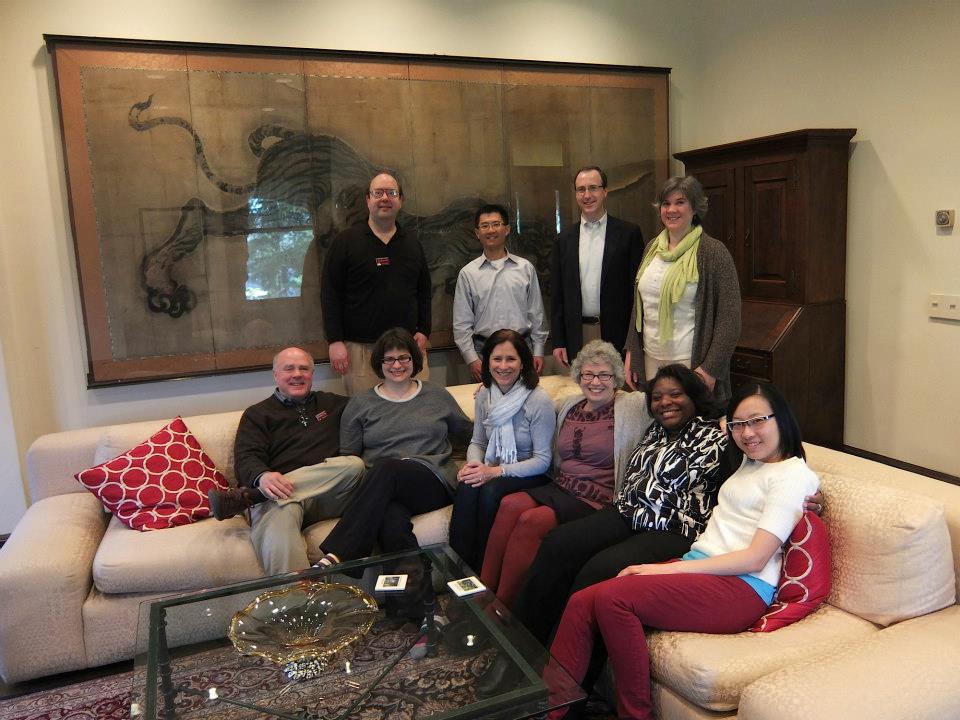
Swarthmore College Alumni Council Executive Committee (2011-13)
A Visit to the National World War II Museum in New Orleans
The National World War II Museum is in New Orleans. It’s a fantastic complex with exhibits, movies, and live shows. Recently I was lucky enough to do a signing of Home Front Girl there. It was a wonderful experience!
My family met my Swedish relatives in New Orleans for 4 fun-filled days. Joan’s father, Werner Wehlen, left Sweden at the age of 16 in 1913. Werner was the eldest of all his siblings. His youngest brother, Nils-Erik, was born after Werner left. They never met.
Nils-Erik had several children we have met a number of times. Lars is the “baby” brother! Lars is Joan’s first cousin and Gerd is Lars’s wife.
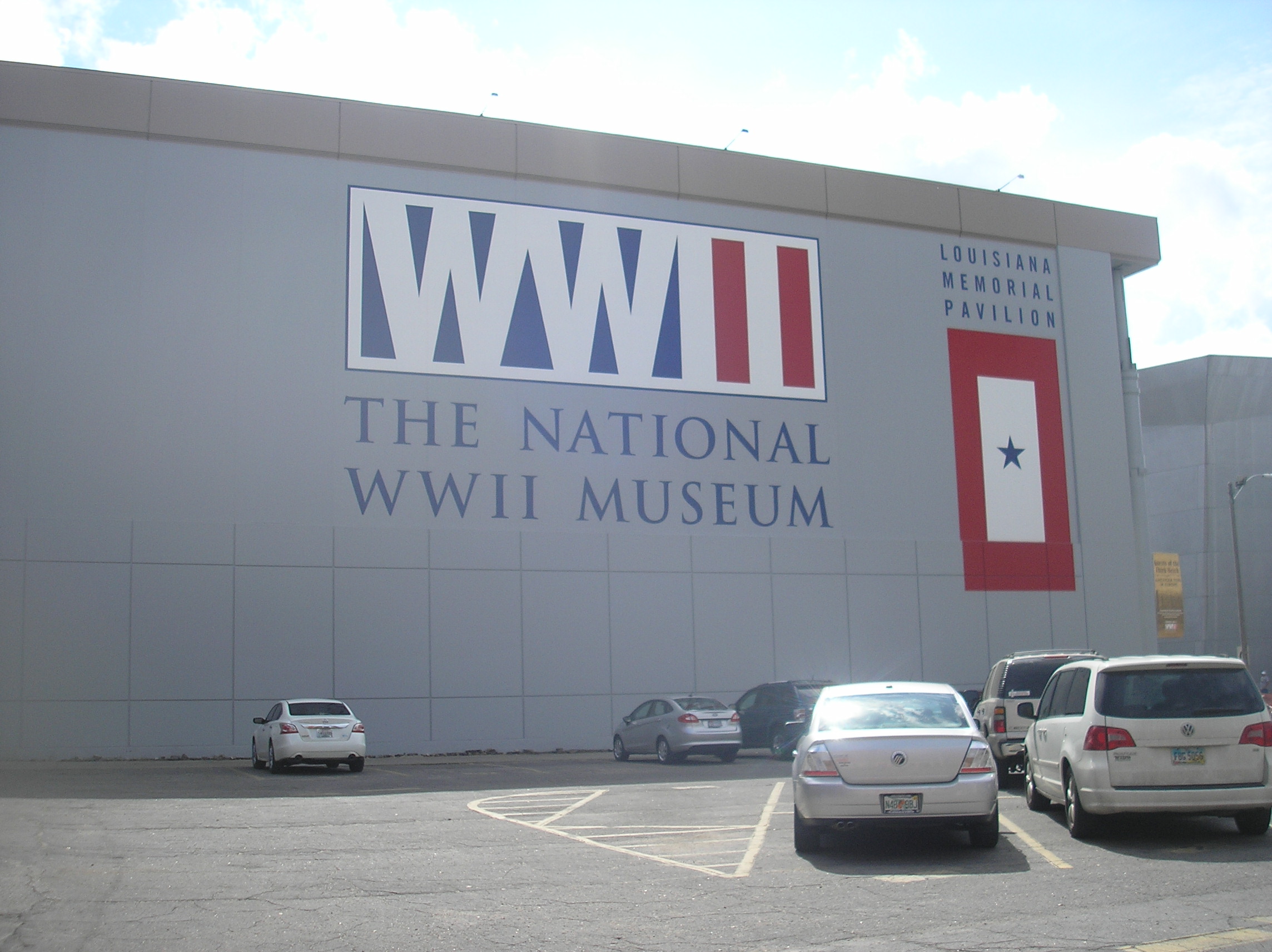
This building has the exhibits, book shop, and gift shop. This addition is under construction.


I took this photo from the top of the Ogden Museum of Southern Art, the fabulous museum Gerd and I visited that is connected to the University of New Orleans.

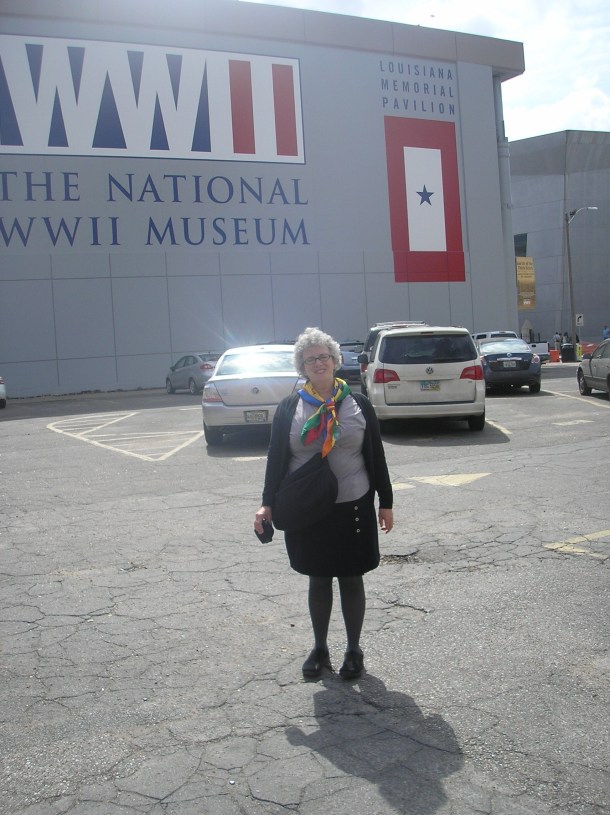
- Susie at the National World War II Museum, in a photo taken by Gerd.


After these photos were taken, I went to sign books for a couple of hours. It was so fun! Everyone who is at the museum came because of their interest in World War II. All photos taken in the museum were taken by Gerd, the wife of Joan’s cousin. Thanks, Gerd!
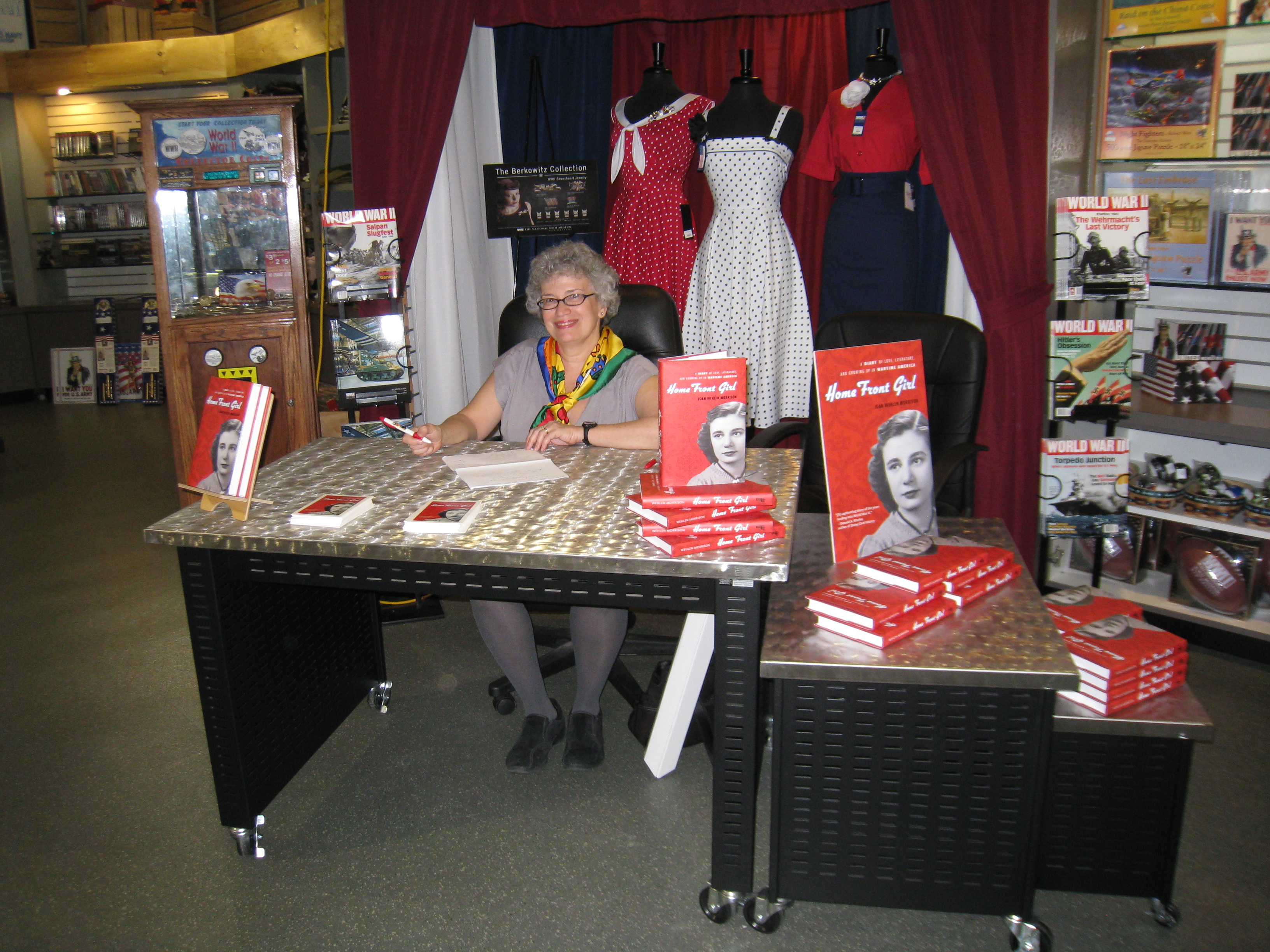
In the National World War II Museum Book Shop, preparing for the signing
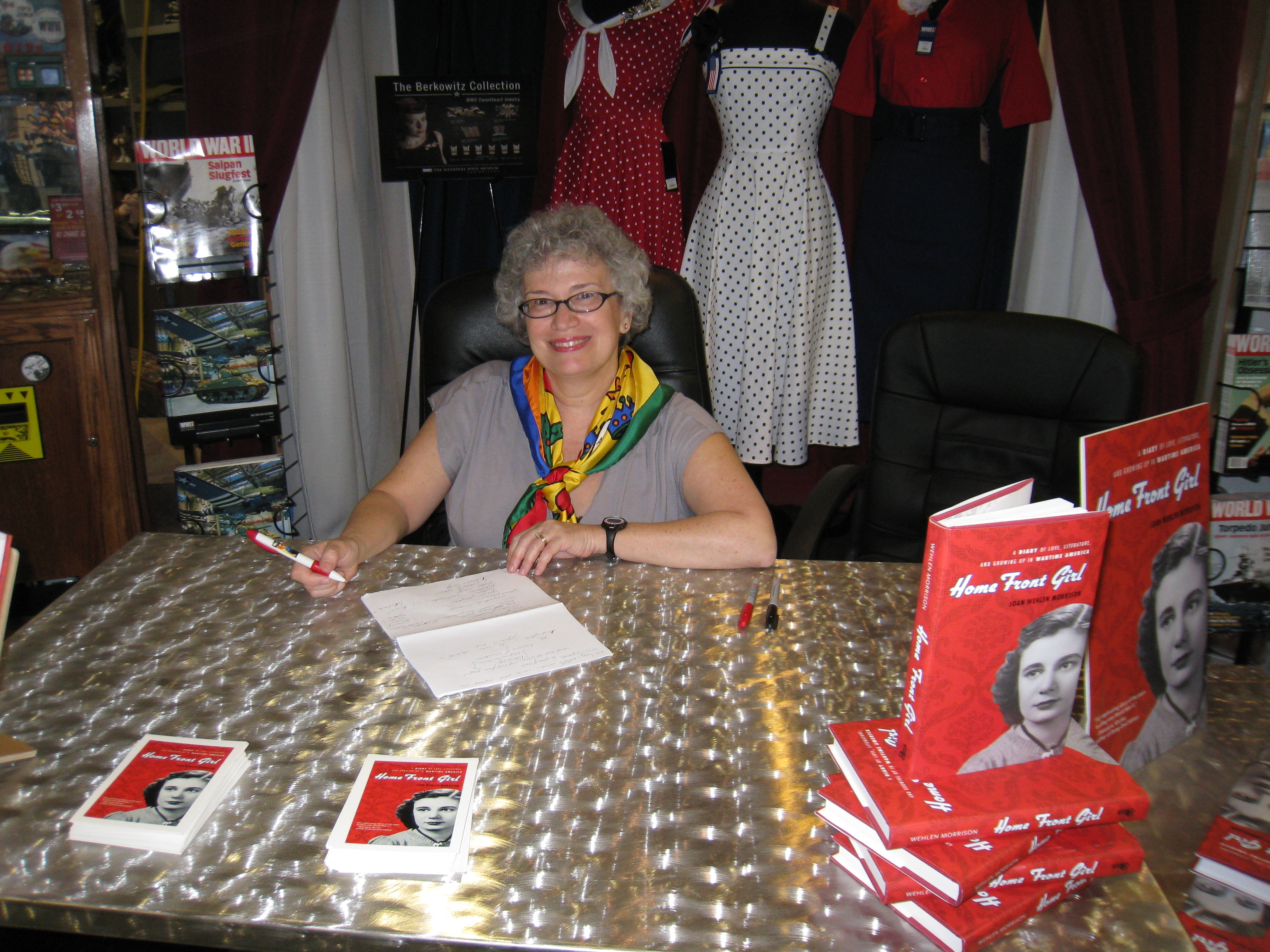
Preparing for the day.
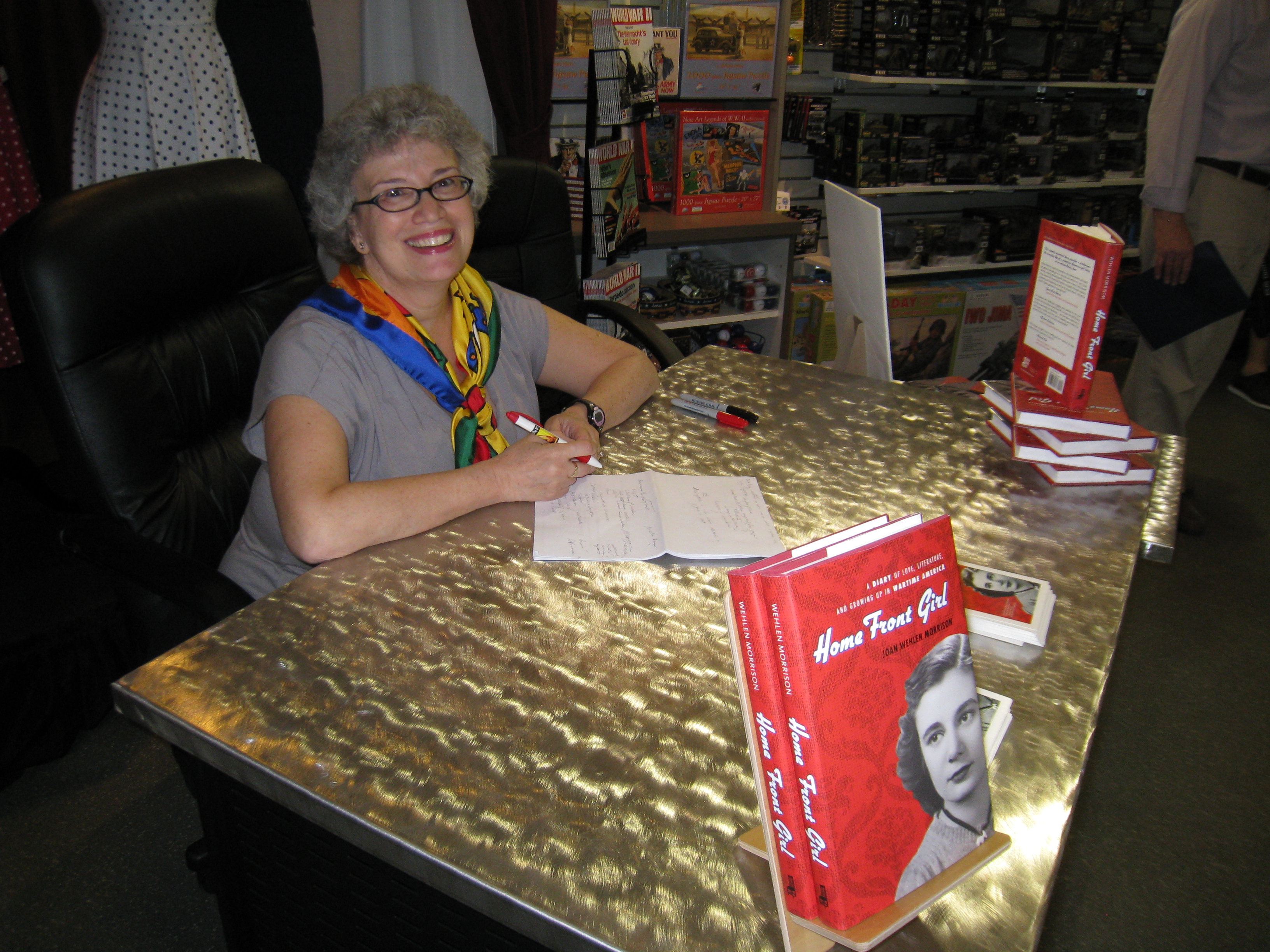
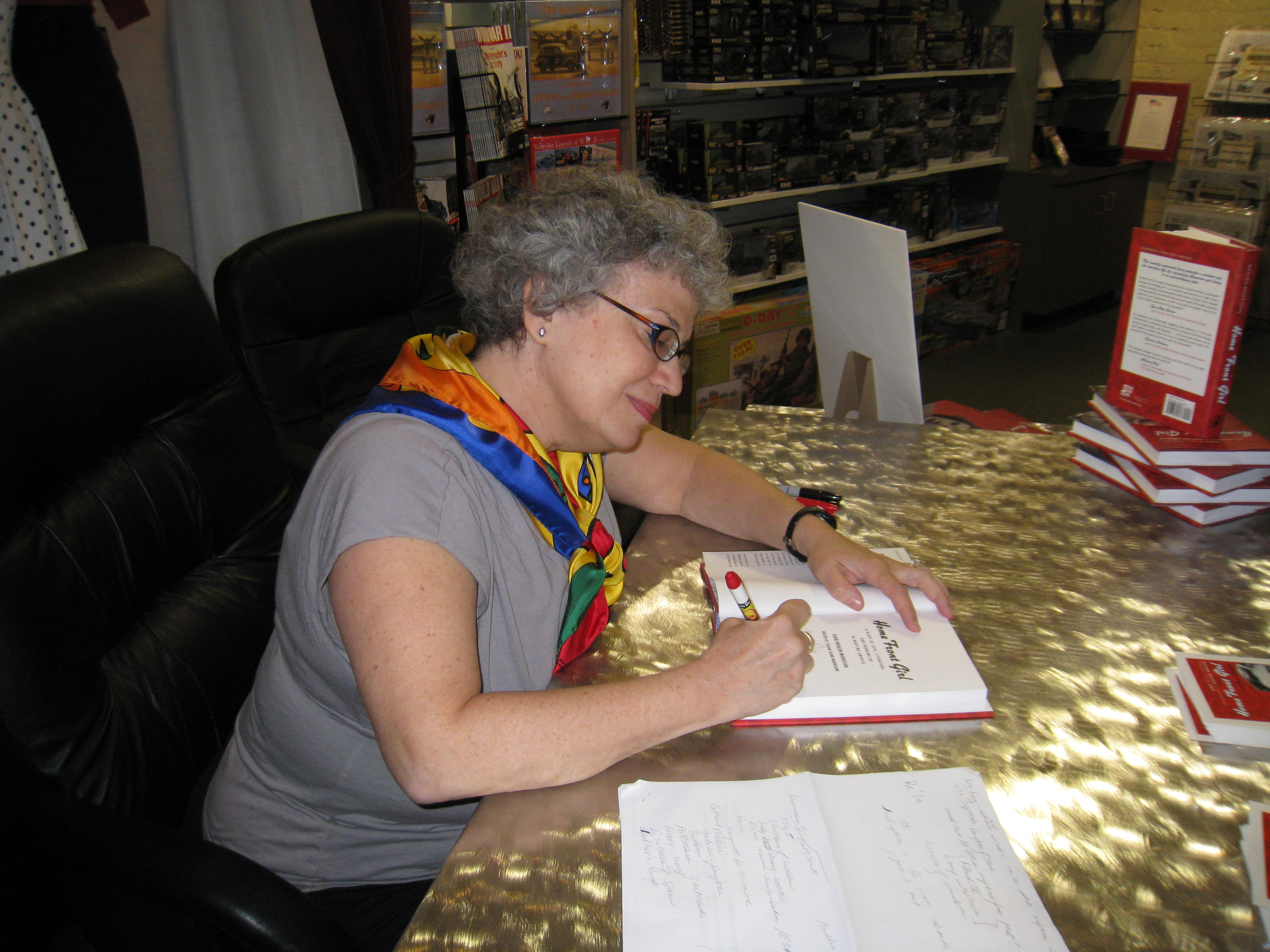
Hard at work signing.
Gerd sat with me for over two hours. We chatted with museum goers about the book. It was a lot of fun!

One sweet customer, Be’la

With a young customer and reader
After the signing, Gerd, John and I saw a movie at the museum, narrated by Tom Hanks, called Beyond All Boundaries. You can play the trailer here. The movie is in 4-D!!! Gerd, who is Swedish, thought it “very American.” John said it was “Awesome!” I think they are both right! Do go!

With Jim, Sarah and John by a lovely corn stalk iron fence outside a hotel in the French Quarter

With Gerd at Cafe du Monde

John enjoying beignets at Cafe du Monde
Invictus: Uncovering my grandparents’ grave markers–in the snow!
In March 2013, my family and I visited Chicago. This is where my mother, Joan Wehlen Morrison, grew up and where she met my father, Bob Morrison, when they both studied at the University of Chicago in the early 1940s. As a girl, we children visited the Windy City about twice a year to visit my grandparents, Werner Wehlen and Neva [Levish] Wehlen.
Werner immigrated from Sweden at the age of 16 in 1913. He never went back. In fact, he never met his youngest brother who was born after he had left! But that brother, Nils-Erik, had a number of children–all of whom we have met and continue to meet! Such is the miracle of life.
My children, Sarah and John, had never visited Chicago before. Nor had they seen their great-grandparents’ gravesites. I insisted that we go pay our respects at Rosehill Cemetary, just north of the Swedish part of Chicago–Andersonville. Very charming people at the cemetery helped us with two maps.

Plan of Rosehill Cemetery, Chicago, Illinois
My grandparents are buried in Section 9, Block Sub. 1, Lot 18, Graves 4 and 5.

My grandparents were somewhere in the yellowed in area!!!
Now was the hard part: we got to Section 9 and even this little area marked in yellow above. But my grandparents did not have gravestones that stood up vertically; they had grave markers that lie flat. How would we ever find them in beautiful but snow-covered lawn!!! And it is fitting that they are buried under snow. Both stem from ancestors used to snow. My mother, Joan, writes on January 30, 1939, about her best friend’s father, Mr. Love, who has just died and been buried on a frosty Chicago day, “Mr. Love has a warm blanket now above him. I’m glad the snow is clean and fluffy.”

-

- With Sarah and John–when will we find Werner and Neva?
-

- At the start of our labors
-

- When will we find them?
-

- Could this be it?
-

- Toiling….
-

- Scraping….
-

- Digging….
-

- Digging…
-

- Digging….
-

- Our first view of success!
-

- And Grandpa too!




-

- A mighty trio photographed by Jim.
-

- Jim and Susie after finding Werner and Neva!
You’ll notice Werner’s grave marker has the word “Invictus” at the top. It means “unconquered” and is the title of one of Werner’s favorite poems by William Earnest Henley.
Out of the night that covers me,
Black as the pit from pole to pole,
I thank whatever gods may be
For my unconquerable soul.
In the fell clutch of circumstance
I have not winced nor cried aloud.
Under the bludgeonings of chance
My head is bloody, but unbowed.
Beyond this place of wrath and tears
Looms but the Horror of the shade,
And yet the menace of the years
Finds and shall find me unafraid.
It matters not how strait the gate,
How charged with punishments the scroll.
I am the master of my fate:
I am the captain of my soul.
This poem epitomizes Werner’s philosophy of life. And my pure coincidence (?), John studied the poem in Social Studies class after our Chicago trip.
After we paid our respects, we headed for Andersonville and the Swedish part of Chicago.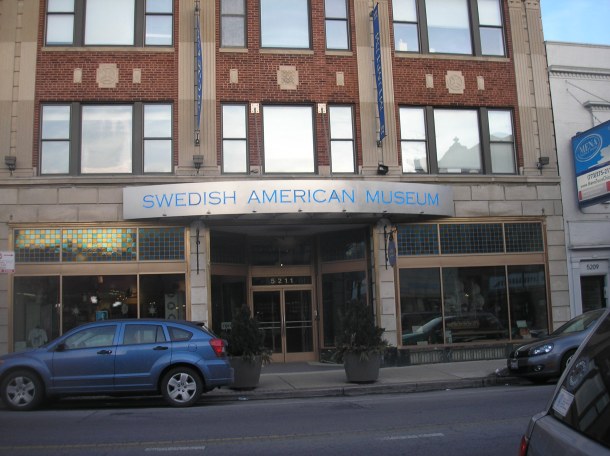

Ann Sather is where we used to eat a delicious Swedish smorgasbord.

We drank a toast to Neva and Werner at a bar he used to take us to: Simon’s. It’s no longer quite the dive it was, but everyone was so friendly and it’s a great place for a drink!


Simon’s Tavern is at 5210 N. Clark Street. A great place for a drink and a toast!
Skol to everyone!
A Visit to Joan’s High School: U-High (Chicago Laboratory Schools)
Not only did I get to meet my publishers at Chicago Review Press in Chicago, but I also got to visit and teach at my mother’s high school: the place she calls “U-High” in her diaries — the place now usually referred to as the University of Chicago Laboratory Schools (K-12).
I first got to teach two classes of U. S. History. The teacher and head of the History Department, Charles Branham, was so gracious and fun. I imagine his classes are filled with wonderment and pizzazz! They assured me that Joan’s $300 scholarship, that enabled her to attend the school in the fall of 1938, would have to be much larger today!

Here is lovely U-High!
Then I spoke to a huge lunch crowd. It seemed that in addition to the principal, Chris Janus, there were at least 50 students there! They were good sports and laughed at all of my mom’s jokes. And they asked good questions.
Finally I had a wonderful time in the classes of a kindred spirit, Cindy Jurisson. The first class we focused on Medieval Women (one of my teaching specialties). Cindy had trained her students to take excellent, thorough notes and they had already covered a lot of ancient women writers and women’s history. The next class focused on Home Front Girl.
Students were very happy to join in the spirit of Joan’s hi-jinks. There is one fun “dialogue” in the diary that seems almost like a play. A male friend, Frazier, and Joan are walking down the hall together in early 1939.
He: “Do you believe in heaven and hell, Joan?”
I (overcome by conservation of matter): “No, I’m afraid I don’t. I suppose that disagrees with you?”
He: “No, it doesn’t. That’s good. I don’t either. What do you believe in?”
Me: “Oh, I don’t know—conservation of matter right now. It’s awfully compelling.”
He: “Yes, it is. I guess I believe in that, too. But doesn’t that disprove immortality?”
I: “Oh, I don’t know. It means we’ll live again in flowers, doesn’t it?”
He: “Yes . . . Mr. Mayfield (Bio Sci teacher) makes it all so personal, doesn’t he? . . . You know—I wanted to be cremated.”
I: “Oh, do you? I used to want to, too, but now it seems as though I’d be cheating the Earth . . . you know.”
He: “Yes, I know.”
I: “I did want to be cremated, but now I feel a sort of duty toward the Earth . . . Of course it seems awful to rot away in the . . .”
He: “Yes . . . but I suppose . . . I saw a cremation once!”
Me: “Oh—what was it like?” (I wanted to asked how it smelled, but he thinks I’m crude as it is.)
He: “Oh, it was behind a glass wall and it shriveled up and . . .”
I: “Oh—Oh!” (thinking rotting in the cool sweet earth is more natural)
He: “And then . . ..”
And so we reached the locker room and I staggered to Modern Dance.
Here I am with one of the wonderful students–he was willing to play “Frazier” and I was “Joan.” It was really funny!
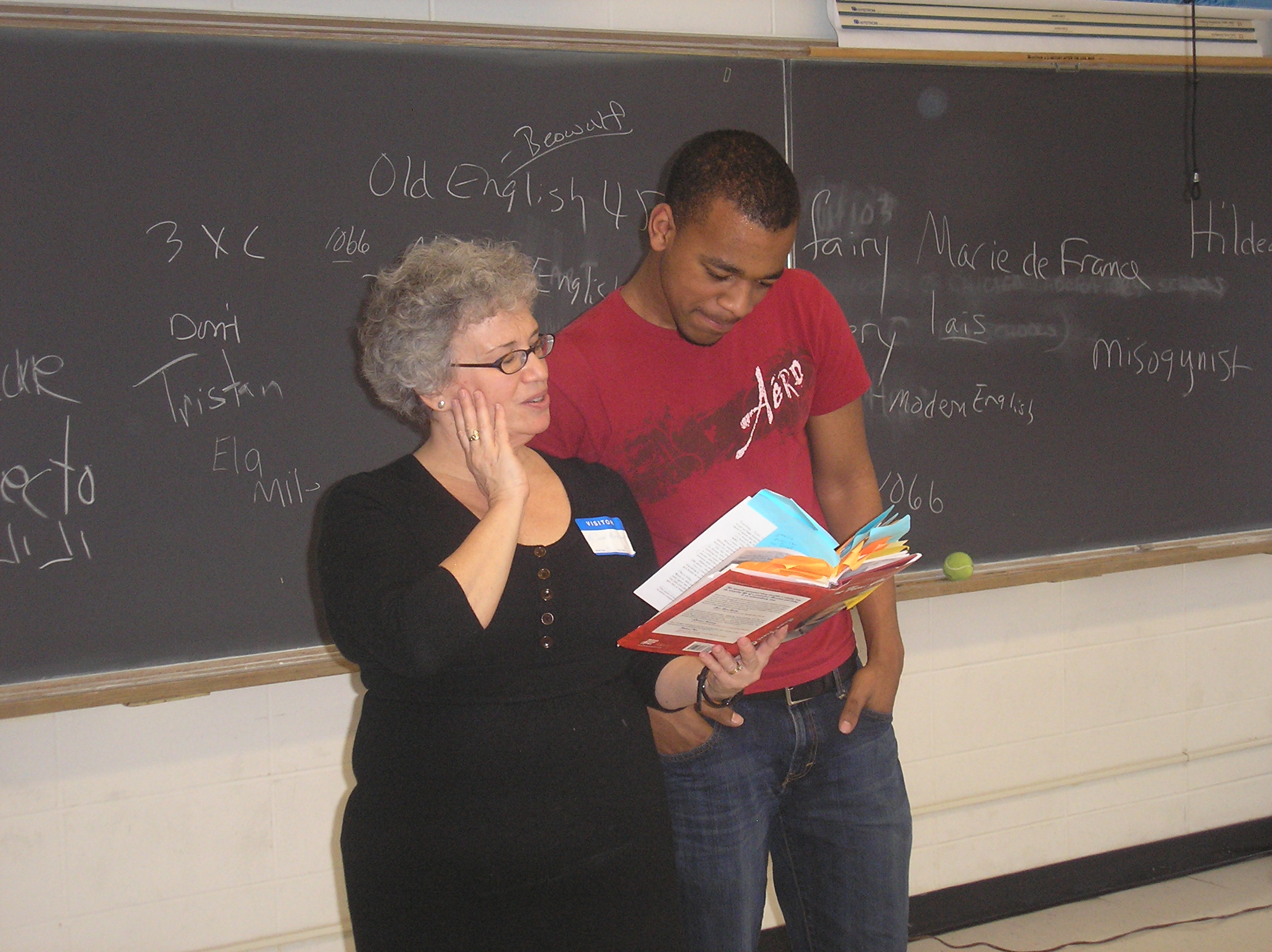
Here we are as Frazier and Joan.
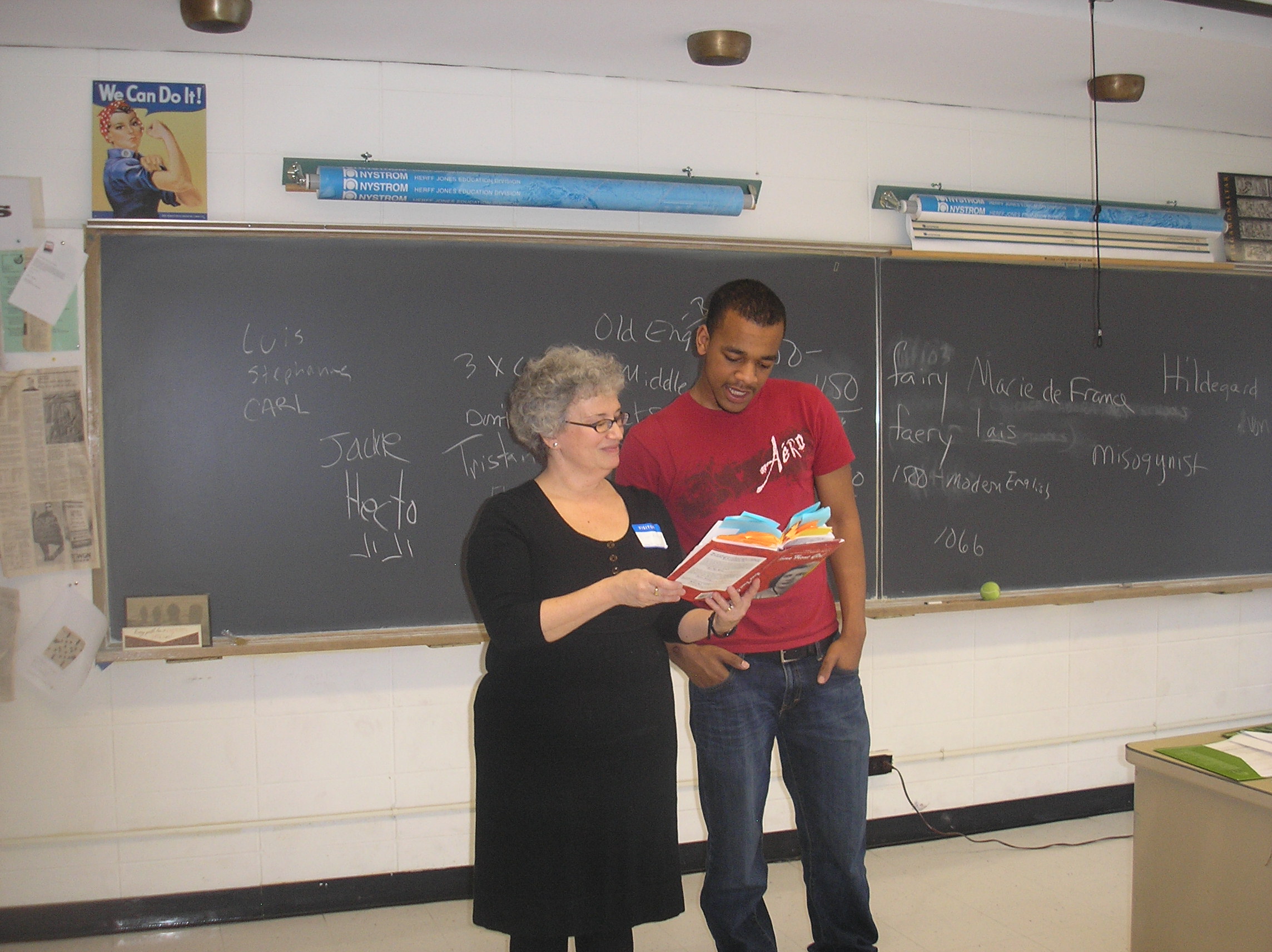
More hi-jinks!
I hope we can have an encore performance!
A Visit to my Publishers
In March 2013, my family and I had the great pleasure of visiting Chicago, the Windy City! It is also the home of my mother, Joan Wehlen Morrison. And her diaries, now published as Home Front Girl, are set mainly in this wonderfully vibrant city.
Chicago Review Press is in Chicago. I first made contact with my editor, Lisa Reardon, in November 2011. And so for almost 1 1/2 years, she and I have emailed. But we had never met each other! Nor had I met the publicity folks, Mary Kravenas and Caitlin Eck. But finally, I have!

There is nothing like putting a face and a tone of voice to the people you’ve only corresponded with via email! And what a pleasure it was to meet with kindred spirits! I hope we’ll meet again!

By the door of Chicago Review Press.

 Home Front Girl